
In New Jersey, I’d budget about $5 to $8 per paintable square foot or roughly $6,000 to $20,000+ for a 2,000-square-foot interior repaint. That’s the short answer.
Here’s what matters most if you’re pricing the job:
- Small jobs cost more per square foot because setup and travel still count.
- Older homes, wall repairs, and lead-safe prep can push prices up fast.
- Ceilings, trim, doors, closets, and stairwells are often priced separately.
- Wallpaper removal, popcorn ceiling removal, and heavy repairs are common extra charges.
- A written quote should spell out coats, prep, paint brand, included surfaces, and exclusions.
A few fast numbers from the article:
- Per square foot: $5 to $8
- Small bedroom: about $400 to $1,000+
- Living room: about $900 to $2,500+
- 1,200 to 1,500 sq. ft. home: about $5,488 to $9,995
- 2,000 to 2,500 sq. ft. home: about $6,000 to $20,000+
- Drywall repair: about $150 to $500, or $20 to $50 per hour
- Contingency to add: 10% to 15%
If I were comparing quotes, I’d focus on one thing: what’s included and what’s not. A low price for walls only can look good at first, but once ceilings, trim, repairs, and primer get added, the total can shift a lot.
The article breaks all of that down into simple pricing ranges, budget planning steps, and the extra charges that tend to show up late.
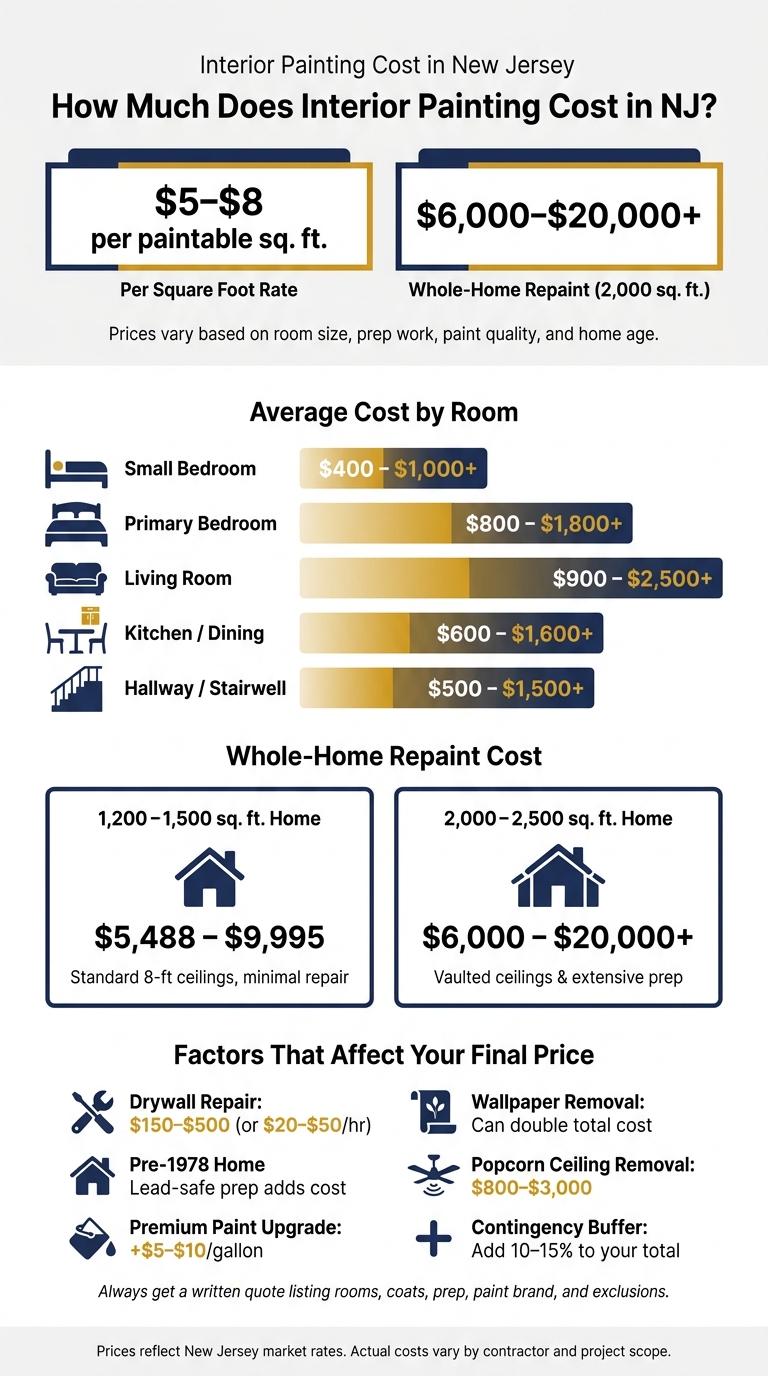
Interior Painting Cost in New Jersey: At-a-Glance Price Guide
How Much Does It Cost To Paint 3,000 Sq Ft Interior House? #interiorpainting
sbb-itb-a2baf13
Typical Interior Painting Costs in New Jersey
In New Jersey, interior painting prices are usually quoted in one of three ways: per square foot, per room, or as a flat price for the whole house. What you end up paying comes down to the size of the job and the condition of the surfaces. If walls need patching, sanding, or other prep, the price goes up.
Average Cost per Square Foot
Most painters in New Jersey charge $5 to $8 per square foot. That rate is based on paintable wall area, not your home’s floor area. In most cases, it also includes basic prep work.
Smaller jobs often cost more per square foot. Why? Setup time, travel, and minimum job charges still apply, even if the painter is only doing one room. On the flip side, larger whole-home jobs can land at a lower per-square-foot rate because those fixed costs are spread across more space.
Average Cost per Room
Per-room pricing makes sense if you’re painting just a few rooms or if each space has its own level of difficulty. Costs go up with taller ceilings, extra trim, more doors, and repair work.
| Room Type | Low Range | Mid Range | High Range | Notes |
|---|---|---|---|---|
| Small Bedroom | $400 | $700 | $1,000+ | Trim, doors, and repairs can push the price higher |
| Primary Bedroom | $800 | $1,200 | $1,800+ | Higher cost for vaulted ceilings or large closets |
| Living Room | $900 | $1,500 | $2,500+ | Crown molding and mantels increase complexity |
| Kitchen / Dining | $600 | $1,000 | $1,600+ | Excludes cabinet refinishing |
| Hallway / Stairwell | $500 | $900 | $1,500+ | High ceilings and ladder work increase labor |
Average Cost for a Whole-Home Interior Repaint
For full-house projects, painters often give one flat quote instead of breaking out every room. For a 1,200–1,500 sq. ft. home, expect to pay $5,488 to $9,995. A 2,000–2,500 sq. ft. home usually costs $6,000 to more than $20,000. That top end tends to show up when the home has vaulted ceilings, detailed trim, or a lot of prep work.
| Home Size | Low Range | Mid Range | High Range | Typical Scope |
|---|---|---|---|---|
| 1,200–1,500 sq. ft. | $5,488 | $7,700 | $9,995 | Standard 8-ft ceilings, minimal repair |
| 2,000–2,500 sq. ft. | $6,000 | $13,000 | $20,000+ | High end reflects vaulted ceilings and extensive prep |
Factors That Affect the Cost of Interior Painting
These price ranges can shift fast. Prep work, room layout, paint type, and labor conditions all play a part. Two homes with the same square footage can end up at very different price points based on those details alone.
Wall Condition, Prep Work, and Older Homes
Wall condition is one of the biggest drivers of price. Nail holes, dents, cracks, stains, and peeling paint all need attention before any paint goes on the wall. In New Jersey, drywall repair usually costs $20 to $50 per hour, and patching often adds $150 to $500. Skip prep, and the result can peel early and lead to costly fixes.
If your home was built before 1978, plan for added expense. Many older New Jersey homes call for lead-safe prep practices, which increase labor time and total project cost.
And once repairs enter the picture, labor can climb fast. Add trim, doors, or ceilings to the scope, and the job gets more time-intensive.
Ceilings, Trim, Doors, and Room Complexity
Wall-only painting is usually the lower-cost option. Add ceilings, trim, doors, and closets, and labor hours can jump fast, even in a small room. Vaulted ceilings and stairwells often need special ladders or scaffolding, which adds setup time and extra safety steps.
Detailed features also slow things down. Wainscoting, built-ins, and ornate casings take more work than flat walls. That means a room with lots of trim detail can cost far more than its square footage might suggest.
Paint Quality, Color Changes, and Local Labor Rates
Paint quality affects both what you pay now and how the finish holds up over time. Contractor-grade paint keeps material costs lower. Premium products like Sherwin-Williams Emerald or Benjamin Moore Aura cost more per gallon. Premium paints cost more per gallon but can improve durability, washability, and color retention. In plain English: you pay more upfront, but you may deal with fewer touch-ups later.
Color changes can add a lot of labor. Going from a dark wall to a light one, or the other way around, often takes specialty primers and extra coats to get even coverage. Accent walls and multiple paint colors across the home also add time and materials.
Access matters too. Dense urban jobs and occupied homes often take longer because painters have to work around furniture, staging, and building rules.
Use these factors to turn the price ranges above into a more realistic budget.
How to Build a Realistic Painting Budget
Use the cost drivers above to turn those price ranges into a budget you can actually work with.
When to Use Per-Room vs. Per-Square-Foot Pricing
For New Jersey projects, per-room pricing works best when you’re painting one or two rooms. If you’re planning a whole-home repaint, per-square-foot pricing usually makes more sense.
That said, floor area is only a rough shortcut. It doesn’t tell the whole story. Higher ceilings, stairwells, crown molding, wainscoting, and other architectural details add labor that simple floor measurements miss. If you want a better estimate, base it on wall area, not floor area.
How to Add Cost Allowances for Prep, Ceilings, and Paint Quality
Start with a base rate of $5 to $8 per square foot for standard wall painting in New Jersey.
Then layer in extra costs for anything beyond basic walls:
- Repairs and patching: Budget $150 to $500 for drywall work.
- Ceilings and trim: Set aside a separate allowance for ceilings, trim, and detailed molding.
- Paint quality upgrade: Premium paint can add $5 to $10 per gallon.
- Color changes: Dark-to-light or light-to-dark changes often need extra primer and more coats.
It’s also smart to add a 10% to 15% contingency for hidden issues. Old wall damage, uneven surfaces, or surprise patching can push the total up fast.
A Simple Budget Planning Worksheet
Use this worksheet to sketch out a rough budget.
| Room Name | Approx. Wall Sq. Ft. | Base Cost ($5–$8/sq ft) | Prep Allowance | Ceiling & Trim Allowance | Estimated Total |
|---|---|---|---|---|---|
| Living Room | 450 | $2,250 – $3,600 | $150 | $400 | $2,800 – $4,150 |
| Primary Bedroom | 320 | $1,600 – $2,560 | $50 | $150 | $1,800 – $2,760 |
| Hallway | 180 | $900 – $1,440 | $50 | $100 | $1,050 – $1,590 |
| Subtotal | 950 | $4,750 – $7,600 | $250 | $650 | $5,650 – $8,500 |
| Contingency (10–15%) | – | – | – | – | +$565 – $1,275 |
| Project Total | – | – | – | – | $6,215 – $9,775 |
Fill in your own rooms using the same setup. The range gives you a quick gut check when quotes start coming in. If one price looks way too low or way too high, this baseline helps you spot it.
How to Compare Quotes and Avoid Surprise Charges
Once you have a budget range, use the written quote to check what’s actually included.
What a Clear Interior Painting Quote Should Cover
A good quote should show the scope of work line by line, not just one total at the bottom. Before you sign, make sure the estimate lists the rooms, number of coats, primer, covered surfaces, whether that means walls only or ceilings and trim too, the exact paint product used, prep steps, insurance, timeline, cleanup, and lead-safe procedures for pre-1978 homes.
That paint detail matters more than people think. “Premium paint” sounds nice, but it doesn’t tell you much. You want the actual product listed in writing.
If something doesn’t appear in the quote, treat it as excluded until the contractor says otherwise in writing.
Common Add-On Charges to Watch For
This is where budgets often drift. Some charges don’t show up in the base quote, then land on the final bill later.
Wallpaper removal is often left out of standard quotes and can double the total cost. Major drywall repair is usually billed on its own at $20 to $50 per hour. Popcorn ceiling removal can cost $800 to $3,000, depending on room size and safety rules.
Other charges that often catch homeowners off guard include:
- Water-damage repair
- Specialty finishes
- Moving heavy furniture
- After-hours scheduling for occupied spaces
One of the best questions you can ask is simple: What is not included in this price? That’s usually where the biggest cost gaps show up.
Conclusion: Planning Your NJ Interior Painting Budget
Use the quote as the last check on your budget, not the first number that grabs your attention. A solid budget brings together your measurements and a written quote that spells out scope, prep, materials, and exclusions.
FAQs
How do I calculate paintable square footage?
Measure the room’s perimeter by adding the length of each wall. Then multiply that number by the ceiling height to get the total wall area.
Next, subtract any spaces you won’t paint:
- 20 square feet for each door
- 15 square feet for each window
What’s left is your net paintable wall area. Divide that number by 350 square feet to estimate how many gallons of paint you’ll need for each coat.
Is it cheaper to paint the whole house at once?
Yes. Painting the whole house at once is often more efficient than tackling one room at a time.
The upfront cost is higher, sure. But bundling rooms can cut down on repeat setup, masking, surface protection, and equipment use. It also helps the prep work stay consistent and gives your home a more even finish and overall look from room to room.
What should I ask before accepting a quote?
Before you say yes to any quote, ask for an itemized written estimate that lays out the full scope of work. That should include surface prep, repairs, priming, the paint brand, the finish, and the number of coats.
You’ll also want to confirm a few job-site details upfront:
- Liability and workers’ compensation insurance
- Lead-safe certification for homes built before 1978
- Who handles furniture moving, floor protection, and hardware
- The warranty terms for workmanship
This step can save you a lot of hassle later. A clear estimate makes it much easier to compare bids and spot gaps before the work starts.