
In New Jersey, most exterior house painting jobs cost about $4,500 to $18,000 – or $2.20 to $5.50 per square foot of paintable area. If I’m comparing quotes, I should focus on prep, height, siding type, paint system, and lead-safe work, not just the total price.
Here’s the short version:
- Small one-story homes often start around $4,500
- Mid-size two-story homes often land around $6,000 to $12,000
- Larger or taller homes can run $10,000 to $18,000+
- Two-story homes can cost 25% to 40% more than a similar one-story house
- Heavy prep can make a job 30% to 50% higher
- Older pre-1978 homes may cost more because of lead-safe rules
- Wood and stucco usually cost more to paint than vinyl or aluminum
A big point: interior square footage is not the same as paintable exterior area. A 2,000-square-foot home may have 2,500 to 3,500+ square feet of outside surface to paint.
If I want to judge a quote fast, I look for three things:
- What surfaces are included
- How much prep is listed
- What paint and how many coats are included
| Main cost factor | What it does to price |
|---|---|
| Home size | More surface means more labor and paint |
| Number of stories | Higher homes need more setup and slower work |
| Siding type | Wood and stucco often need more prep |
| Prep work | Scraping, sanding, repairs, and caulking add labor |
| Paint system | Better primers and topcoats cost more |
| Pre-1978 lead rules | Containment, cleanup, and paperwork add cost |
Bottom line: if one quote is far lower than the rest, I’d check what’s missing. In many cases, the low bid leaves out prep, repairs, trim, or lead-safe steps.
How much does it cost to paint an exterior home in 2024
sbb-itb-a2baf13
How Home Size and Siding Type Affect the Final Price
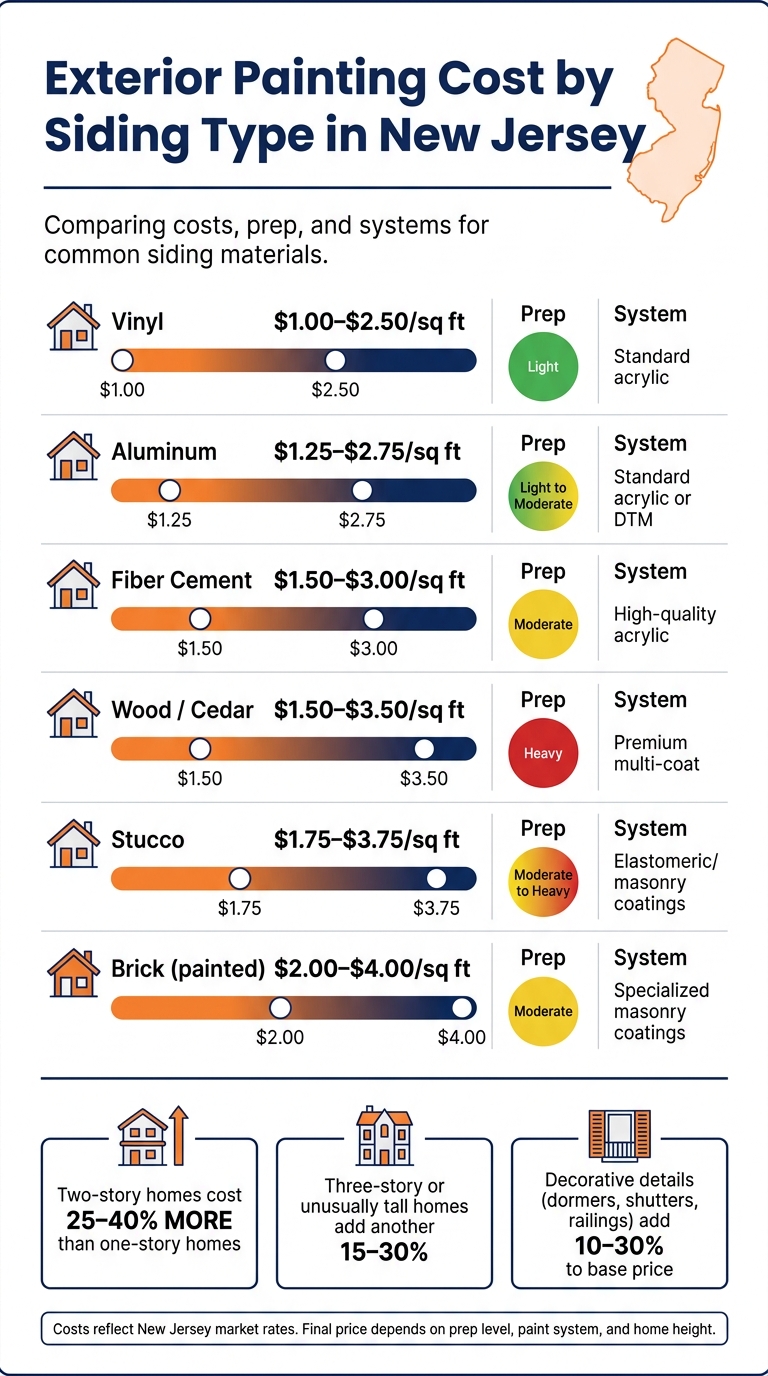
Exterior Painting Cost by Siding Type in New Jersey (2024)
Cost Ranges by Home Size and Number of Stories
Once you know the starting price range, home height and siding type usually drive the next big jump in cost.
A one-story ranch is usually faster to paint because most of the work can be done from the ground or a short ladder. A two-story colonial is a different story. Crews need extension ladders, more setup, more repositioning, and more time working at height. That extra labor shows up in the final bill.
For a full repaint, one-story homes usually cost less because the crew can work faster and with less risk. In New Jersey, two-story homes can cost 25–40% more than a similar one-story home with the same siding and square footage. If the home is three stories tall, or just unusually tall, the price can climb again. Full scaffolding or lift equipment may be needed, which can push costs another 15–30% higher than a similar two-story job. In plain English: access, safety setup, and slower production up high can matter just as much as the size of the house.
Siding Materials and Exterior Features That Change the Cost
Siding material has a direct effect on prep work, and prep work is where a lot of labor hours go.
Vinyl and aluminum tend to be the easiest to deal with. In many cases, they mostly need power washing, minor repairs, and sometimes a light scuff before paint is applied. Wood siding usually takes more effort, especially on older New Jersey homes. Peeling paint, soft spots, and gaps often mean scraping, sanding, caulking, and spot-priming before the finish coats even start. That adds a lot of labor time.
Stucco brings its own set of issues. Small cracks need patching, and the surface often needs elastomeric or masonry coatings. Those products cost more per gallon and usually take longer to apply the right way.
Then there are the details homeowners often overlook. Dormers, gables, soffits, fascia, shutters, and porch railings all take slower, more careful brush work. Add multiple accent colors, and the job gets even more time-heavy because of extra masking, more color changes, and the need to keep lines clean. Those details can add 10–30% to the base price.
Siding Type vs. Typical Cost: Comparison Table
| Siding Type | Typical NJ Cost (per sq. ft.) | Prep Intensity | Typical System |
|---|---|---|---|
| Vinyl | $1.00–$2.50 | Light (washing, minor repairs) | Mostly standard acrylic; premium for deeper or darker colors |
| Aluminum | $1.25–$2.75 | Light to moderate (cleaning, deglossing) | Standard acrylic or upgraded DTM products |
| Fiber Cement | $1.50–$3.00 | Moderate (caulking, priming cut edges) | High-quality acrylic; some manufacturer specs require premium |
| Wood / Cedar | $1.50–$3.50 | Often heavy (scraping, sanding, caulking, priming) | Frequently premium multi-coat systems |
| Stucco | $1.75–$3.75 | Moderate to heavy (crack repair, patching) | Premium masonry or elastomeric coatings |
| Brick (painted) | $2.00–$4.00 | Moderate (cleaning, efflorescence treatment) | Specialized masonry coatings required |
Stucco often costs more when crack repair and specialty coating are required.
After size and siding, surface prep and paint system choice create the next major cost swings.
Surface Prep, Paint Quality, and Labor Costs Explained
After size and siding, prep, paint system, and labor account for most of what’s left in the price. And in many cases, prep work and labor – not just the paint itself – are the main reason two quotes for the same house can look so far apart.
Light Prep vs. Heavy Prep: What Changes the Estimate
Light prep covers the standard stuff: power washing, light scraping, minor sanding, spot caulking, and touch-up priming. If a home has been kept up well, the crew can move fast, and prep usually adds about 10–20% to the total cost.
Heavy prep is where things change. If the house has peeling paint, mildew, cracked caulk, or damaged trim, the job gets bigger in a hurry. Crews may need to do deep scraping, more sanding, mildew treatment, broad caulking, and spot priming anywhere the surface is bare. If there’s wood rot or damaged siding, repair work can push the price up even more.
That kind of prep can make the estimate 30–50% higher than a similar light-prep project. And on older homes with several failing paint layers, the difference can climb to 50–75% once lead-safe rules are part of the job.
Standard vs. Premium Exterior Paint Systems
Paint brand matters less than the full paint system: primer, number of coats, and the grade of product used. A standard system usually includes the right primer for the surface, plus one or two coats of mid-grade acrylic latex. That setup works well for newer siding in decent shape or for projects where the upfront price matters most.
A premium system steps things up with a surface-matched primer – like a bonding primer for chalky areas or a stain-blocking primer for tannin-rich wood – followed by two full coats of a durable, UV-resistant topcoat. Premium products can cost 50–100% more per gallon than standard options, which can add several hundred dollars to more than $1,000 in material cost on a full-house job.
What do you get for that extra spend? Better color hold and a longer service life. Good exterior systems can last 8–15 years, while lower-cost products on poorly prepped surfaces may fail much earlier. For homes near the Jersey Shore or in areas with a lot of direct sun, that added durability often justifies the higher material bill.
Cost Breakdown Table: Labor, Materials, Prep, and Compliance
The table below shows how these costs often break down in a typical exterior painting quote for a mid-sized pre-1978 New Jersey home with moderate prep needs. The percentages reflect common contractor pricing ratios.
| Cost Category | What’s Included | Example Cost (USD) | % of Total |
|---|---|---|---|
| Labor | Painting, setup, cleanup, supervision | $3,600 | ~45% |
| Prep & Repairs | Power washing, scraping, sanding, caulking, priming, minor wood repairs | $2,000 | ~25% |
| Materials | Primer, finish paint, caulk, patching compounds | $1,600 | ~20% |
| Lead-Safe Compliance | EPA Lead-Safe containment, disposal, PPE, documentation | $800 | ~10% |
| Total | $8,000 | 100% |
For pre-1978 homes, lead-safe rules add costs for containment, cleanup, disposal, and documentation. Those charges usually show up under labor and compliance.
How to Budget and Compare Exterior Painting Quotes in New Jersey
Once you know what drives exterior painting cost, compare quotes by scope, not just price. The biggest mistake is looking only at the total. Two quotes for the same house can look miles apart on paper and still cover very different work. That’s why the quote itself is one of your best budget tools.
What a Detailed Exterior Painting Quote Should Include
A reliable quote should spell out the full scope in writing. At a minimum, it should list:
- Paintable square footage
- Included surfaces, such as siding, trim, shutters, doors, railings, and foundation
- Prep steps
- Paint line
- Coat count
- Repairs
- Cleanup
- Timeline
- Warranty terms
For pre-1978 homes, the quote should also list EPA lead-safe compliance, including containment, cleanup, and disposal. If a bid for a pre-1978 home leaves out lead-safe work, that’s a red flag, even if the price looks good.
Watch for vague phrases like "standard prep included" or "one coat as needed." That kind of wording can hide big gaps in scope. Ask the contractor to be specific. Which elevations will be fully scraped? Is primer counted as one of the finish coats? Are shutters and railings included, or billed on the side? Small details like these explain a big share of the price gap between bids.
Sample Cost Scenarios for Common New Jersey Home Types
Use these ranges as quote checks, not exact bids. They help you see whether a quote lines up with your home type and the amount of prep involved.
Example Project Costs: Scenario Table
| Home Type | Approx. Paintable Area | Prep Level | Siding Type | Estimated Cost Range | Main Price Drivers |
|---|---|---|---|---|---|
| Small ranch | 1,500–2,000 sq. ft. | Light | Vinyl or fiber-cement | $2,250–$6,000 | Simple access and minor caulking |
| Two-story colonial | 2,000–2,800 sq. ft. | Moderate | Wood or fiber-cement | $4,000–$11,000 | Height, staging, more trim, and broader scraping |
| Larger stucco home | 3,000–4,000 sq. ft. | Heavy | Stucco/masonry | $7,500–$20,000 | Crack repair, specialty coatings, longer dry times, labor-intensive prep |
If a bid comes in far below the range, ask what’s missing. If it comes in far above, ask whether the price covers premium materials, major repairs, or hard access.
Once you can read a quote this way, it gets a lot easier to judge whether hiring a professional is worth the cost.
When Hiring a Professional Exterior Painter Is Worth the Cost
Once you’ve looked at a few quote ranges, the next call is simple: do it yourself, or bring in a pro?
For some jobs, the answer is pretty clear. If you have a multi-story home, a pre-1978 house, major prep work, or damaged siding, hiring a professional usually makes more sense. Working high off the ground takes more than a ladder and a free weekend. It often means staging, taller ladders, and proper safety gear. And with pre-1978 homes, lead-safe handling is often part of the job, which puts it out of DIY territory for most homeowners.
When a project includes height, lead risk, or repair work, paying for professional labor often helps protect the finish. Paint can only do so much. If the house has warped wood, rotting trim, or mold on the siding, a fresh coat won’t solve the root problem. A pro can spot what needs repair before a brush ever touches the surface.
There’s a money side to this too. Proper prep can help a paint job last 8 to 10 years, while siding replacement can cost far more.
Key Numbers and Next Steps
Skip prep, and paint can start failing within months. That’s the kind of shortcut that looks cheaper up front and costs more later.
Before you ask for quotes, do a quick walkaround and write down what you see:
- Measure the home
- Note peeling paint, soft wood, mildew, and caulk gaps
- Compare each quote line by line for scope, prep, and paint quality
A lower price that leaves out lead-safe compliance or heavy prep isn’t a bargain. It’s a hole in the job scope. And before you sign anything, make sure the contractor is licensed, insured, and, for older homes, EPA Lead-Safe Certified.
FAQs
How do I estimate my home’s paintable exterior area?
Estimate the total square footage of all paintable exterior surfaces, including siding, trim, and accents. Getting this number right matters for your budget because surface type, architectural details, and primer and paint coverage all affect how much material you’ll need.
The condition of the surfaces and access to taller areas can also change the scope of work. 26 Painting, LLC offers free onsite estimates to assess your home and determine your project’s exact requirements.
What usually gets left out of a low exterior painting quote?
Low exterior painting quotes often leave out surface preparation. And that’s usually the most labor-heavy part of the whole job.
Here’s what often gets left out:
- Power washing
- Scraping loose or peeling paint
- Sanding
- Caulking
- Priming
- Lower-grade equipment
- Repairs for rot or moisture damage
When those steps get skipped, the paint may not stick well. The finish may wear out sooner. And what looked cheap at first can end up costing more later.
When is exterior painting worth hiring a pro for?
Hiring a pro makes sense for big or detail-heavy exterior painting jobs, especially when the surface needs a lot of prep work first. That can include power washing, scraping, sanding, and caulking so the paint sticks the way it should.
Pros are also a smart pick for older or historic homes, hard-to-reach spots like second-story siding or soffits, and jobs that call for specialty finishes. They can catch moisture damage early and choose materials that fit your local climate.