
If you need an on-site finish, I’d usually lean toward high-gloss paint. If you want the smoothest spray-shop look, lacquer is often the better fit. That’s the short answer.
Here’s what matters most before you choose:
- Sheen: both are shiny, but lacquer often looks more glass-like
- Dry time: lacquer dries in minutes; many high-gloss paints need hours between coats and weeks to fully cure
- Hardness: lacquer dries harder; high-gloss paint has a bit more give
- Touch-ups: high-gloss paint is usually easier to fix on-site
- Cost: lacquer often costs more because of spray setup, labor, and containment
- Odor: waterborne paint has less smell; lacquer has a strong solvent smell
- Best use: high-gloss paint fits doors, trim, and repainting in place; lacquer fits shop-finished cabinets and millwork
If I were picking for a lived-in New Jersey home or an open business, I’d weigh downtime, smell, repair needs, and budget first – not just shine.
Quick Comparison
| Factor | High-Gloss Paint | Lacquer |
|---|---|---|
| Sheen | Very shiny | Smoother, more glass-like |
| Dry Time | Recoat in hours; full cure can take weeks | Very fast dry and recoat |
| Hardness | Durable with some flex | Harder and more rigid |
| Touch-Ups | Usually easier on-site | Often harder without spray gear |
| Cost | Often lower for on-site work | Often higher |
| Odor | Lower with waterborne products | Stronger smell |
| Common Use | Trim, doors, built-ins, cabinet repainting | Shop-finished cabinets, furniture, millwork |
A lot of paint products reach full cure in about 30 days, while lacquer is often picked for its very short dry and recoat window. So if you want a finish that looks sharp and fits the way the space is used, these seven points are the ones I’d check first.
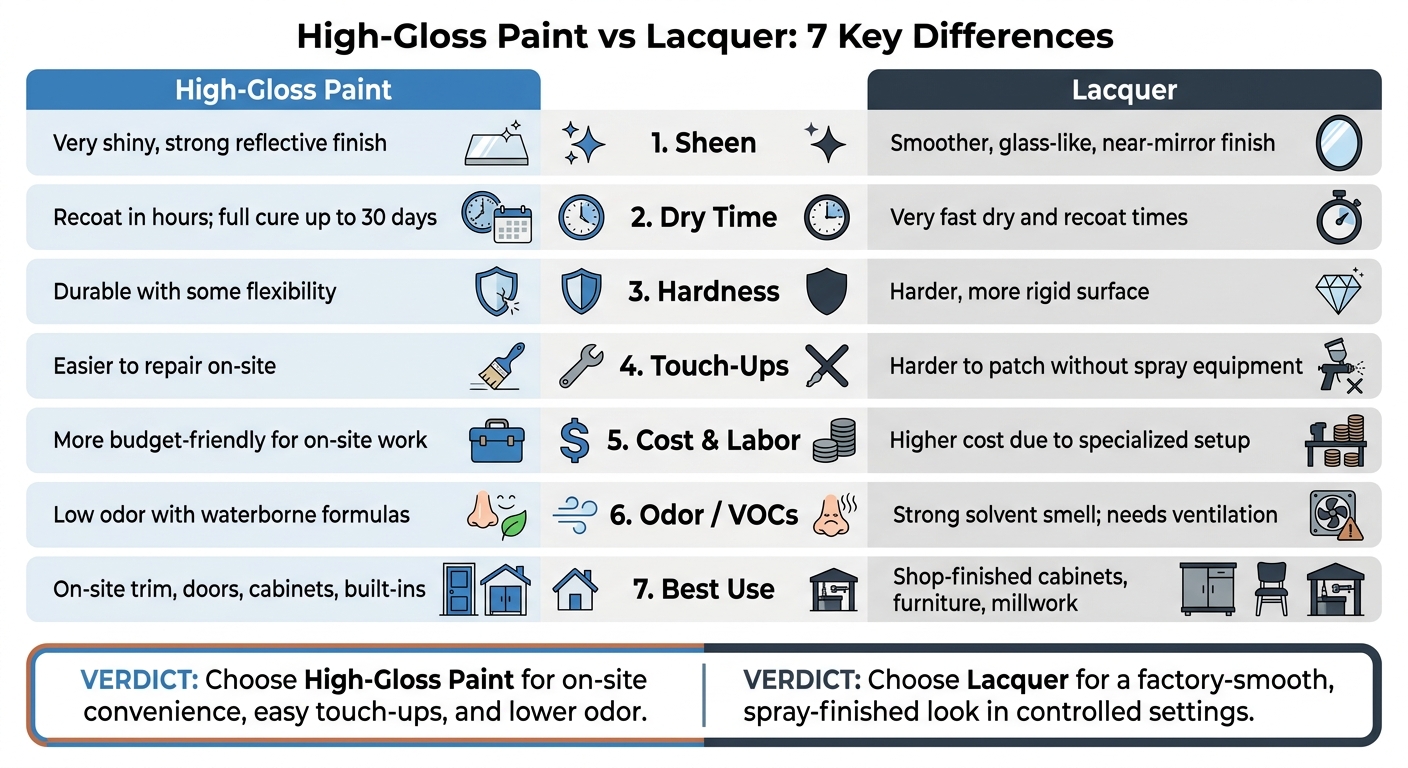
High-Gloss Paint vs Lacquer: 7 Key Differences at a Glance
“High gloss” “Lacquer” “Shiny” – they may sound interchangeable, but in construction, they’re not.
sbb-itb-a2baf13
7 Key Differences Between High-Gloss Paint and Lacquer
Use this side-by-side view to compare the two finishes fast:
| Factor | High-Gloss Paint | Lacquer |
|---|---|---|
| Sheen | Strong shine | Cleaner, glass-like finish |
| Dry Time | Fast recoat; slower full cure | Fast dry and recoat times |
| Hardness | Durable, flexible finish | Hard, rigid finish |
| Repair Difficulty | Easier to touch up on-site | Harder to patch cleanly without spray equipment |
| Cost & Labor | More budget-friendly for on-site work | Higher cost due to specialized setup and containment |
| Odor/VOCs | Lower odor with modern waterborne formulas | Strong solvent odor; requires strong ventilation |
| Typical Uses | On-site interiors | Shop-finished millwork |
The table gives you the quick version. The details below show why those differences matter once the work starts.
1. Sheen and Visual Appearance
Lacquer gives you a cleaner, glass-like finish that can look almost mirrorlike on flat cabinet doors. High-gloss paint brings plenty of shine too.
That said, both finishes are unforgiving. Surface flaws, dents, roller marks, and sanding scratches tend to show up fast, so prep work matters either way.
2. Dry Time and Project Scheduling
Lacquer dries fast and can usually be recoated in short order. That makes it helpful when the goal is to move pieces through a spray setup without much downtime.
High-gloss paint, especially waterborne alkyd enamel, needs several hours between coats and can take several weeks to fully cure. In New Jersey kitchens, offices, and retail spaces, that slower cure can shape the project timeline even if recoating is still fairly fast.
3. Hardness and Durability
Lacquer cures into a harder, more rigid surface than most paint finishes. High-gloss paint, especially waterborne alkyd, also gets very durable over time, but it keeps a bit more flex.
On cabinet doors, built-ins, and other parts that see frequent use, that harder feel can be a plus.
4. Repair and Touch-Up Difficulty
This is where high-gloss paint stands out in day-to-day use. If a door or cabinet frame gets scuffed, a painter can usually handle the touch-up on-site.
Lacquer is tougher to patch cleanly without spray equipment and careful blending. In occupied homes and busy offices in New Jersey, that can turn a small repair into a bigger production. It also shapes planning and labor, which feeds right into cost.
5. Cost and Labor
Lacquer usually costs more to apply. In most cases, it calls for more labor, more equipment, and more prep.
That hits hardest in occupied homes and businesses, where keeping mess, odor, and downtime low matters a lot.
6. Smell, VOCs, and Occupied Spaces
Solvent-based lacquer has a strong odor and needs strong ventilation. That can make it a tougher fit for spaces where people are living or working during the job.
Modern waterborne high-gloss paint systems have a lower odor profile, which makes them easier to use in occupied spaces.
7. Common Uses and Best Project Types
High-gloss paint is the go-to choice for on-site cabinet repainting, interior doors, trim, and built-ins. It works well when the finish needs to be applied in place with a brush or roller.
Lacquer fits shop-finished cabinetry and furniture better, where a controlled spray setup and fast recoat times can do their job. For in-place cabinet refreshes, high-gloss paint is usually the more practical pick.
Where Each Finish Works Best
Best Fit for Cabinets, Trim, Doors, and Built-Ins
Once you know how sheen, hardness, and touch-ups differ, the next step is simple: match the finish to the surface. Start with the item itself and how it will be finished.
High-gloss paint is the practical on-site pick for doors, trim, and other high-touch areas. It works well when the job needs to happen in place and the surface will see regular contact. Lacquer is a better match for spray-only cabinet and built-in work, where a controlled setup can produce that factory-smooth look best achieved by spray.
In day-to-day use, occupancy and maintenance needs usually decide what makes sense.
How Occupancy, Cleaning, and Humidity Affect the Choice
In occupied New Jersey homes and businesses, the choice often comes down to disruption. Use high-gloss paint or waterborne alkyd on-site when odor, cleanup, and downtime need to stay low. Use lacquer when the space can be cleared for spray work and a factory-smooth result matters most.
That’s the tradeoff: on-site convenience or spray-finished precision.
Choosing the Right Finish for Your Property
Match the finish to how the space will actually be used. The main things to weigh are appearance, upkeep, downtime, and budget.
When High-Gloss Paint Is the Better On-Site Option
High-gloss paint makes sense when the finish needs to be applied on-site and kept easy to clean. It offers strong moisture and stain resistance, which makes it a good fit for kitchen cabinets, door frames, and trim. If you want an on-site option that holds up well, waterborne alkyd enamels are a smart pick. They give you oil-like hardness, but with lower odor and easier cleanup.
There’s one catch: high-gloss paint doesn’t hide much. Because it reflects so much light, every dent, scratch, or rough patch tends to stand out. That means careful sanding and priming before application isn’t optional – it’s essential.
When Professional Lacquer Finishing Is Worth the Investment
Lacquer is the better choice when the project can be sprayed off-site or in a controlled setup and the smoothest finish is the top goal. It’s worth the added cost when you need a factory-smooth, spray-finished look.
That can make a lot of sense for kitchen cabinetry, built-ins, or high-visibility millwork in a New Jersey home or commercial property. In those cases, the cleaner, more polished result can justify the extra spend.
Conclusion: Which Finish Is Right for Your Space
After comparing sheen, dry time, hardness, repair, cost, and odor, the choice mostly comes down to how the surface will be used.
High-gloss paint is usually the practical pick for on-site work. It holds up well and is easy to clean. Lacquer is often the better match when you want that smooth, factory-sprayed look, especially for high-end kitchen cabinets or custom built-ins.
The big tradeoff is appearance vs. touch-up ease. High-gloss paint is tough and washable, but it also tends to show flaws. And if you need to fix a spot later, touch-ups on-site can be tricky. Professional sprayed cabinet finishes usually level out more evenly, so they’re often picked when a more uniform luster matters most.
Cost is part of the decision too. Professional cabinet-grade finishes usually cost more, but on high-visibility surfaces, that smoother result can be worth the extra spend.
If you’re weighing durability against a showroom-style finish, match the product to the way the space will be used. If you need help choosing, 26 Painting, LLC can assess the space and recommend the finish that fits the surface and use.
FAQs
Which finish lasts longer on cabinets?
High-gloss usually lasts the longest on cabinets. It stands up best to moisture, stains, and frequent cleaning, which makes it a strong pick if you want a finish that can take daily wear.
Semi-gloss is also durable and easy to scrub, but high-gloss is the tougher option. Lacquer, on the other hand, tends to wear out sooner. Over time, steam, water, and detergents can cause it to wear down, yellow, or turn tacky.
Can lacquer be used in an occupied home?
The available material doesn’t say whether lacquer can be used in an occupied home, so that can’t be confirmed here.
For guidance tied to your project, 26 Painting, LLC offers professional painting services, including cabinet repainting, with solutions tailored to residential properties.
Is high-gloss paint or lacquer easier to maintain?
Yes. High-gloss paint is usually easy to maintain. Its hard, non-porous, moisture-resistant surface helps repel grease, stains, and soap scum.
It also wipes clean without much effort and stands up well to frequent scrubbing. The trade-off is that its shiny finish makes dents, brush marks, and other surface flaws stand out more, so keeping it looking flawless can take a bit more care.