
If I want paint that looks better, covers faster, and lasts longer, I usually spend more up front. That’s the short answer.
Here’s what matters most:
- Premium paint often needs 1–2 coats
- Budget paint may need 2–4 coats
- Premium interior paint can last about 8–12 years
- Budget paint may start wearing out in 2–4 years
- A gallon that costs $80 and lasts 12 years comes out to about $6.67 per year
- A gallon that costs $40 and lasts 4 years comes out to about $10.00 per year
So even though premium paint costs more at the store, it can cut labor, reduce repainting, and hold up better in places like hallways, kitchens, bathrooms, exteriors, trim, and cabinets.
If I were comparing the two, I’d look at four things first:
- Coverage
- Finish quality
- Durability
- Maintenance over time
Quick comparison
| Factor | Premium Paint | Budget Paint |
|---|---|---|
| Upfront cost | Higher | Lower |
| Coats needed | Usually 1–2 | Often 2–4 |
| Coverage | Better hide | Thinner coverage |
| Finish | Smoother, more even | More lap marks, stipple, flashing |
| Adhesion | Stronger on prepped surfaces | More prone to early failure |
| Washability | Better for high-traffic areas | Scuffs and dull spots show sooner |
| Moisture resistance | Better for baths/laundry/exterior use | More likely to blister, peel, or mildew |
| Lifespan | About 8–12 years | About 2–4 years |
| Long-term cost | Often lower per year | Often higher per year |
Put simply: pros use premium paint because the full job cost is not just the price per gallon. It’s also the extra coats, labor hours, touch-ups, and how soon the surface needs to be painted again.
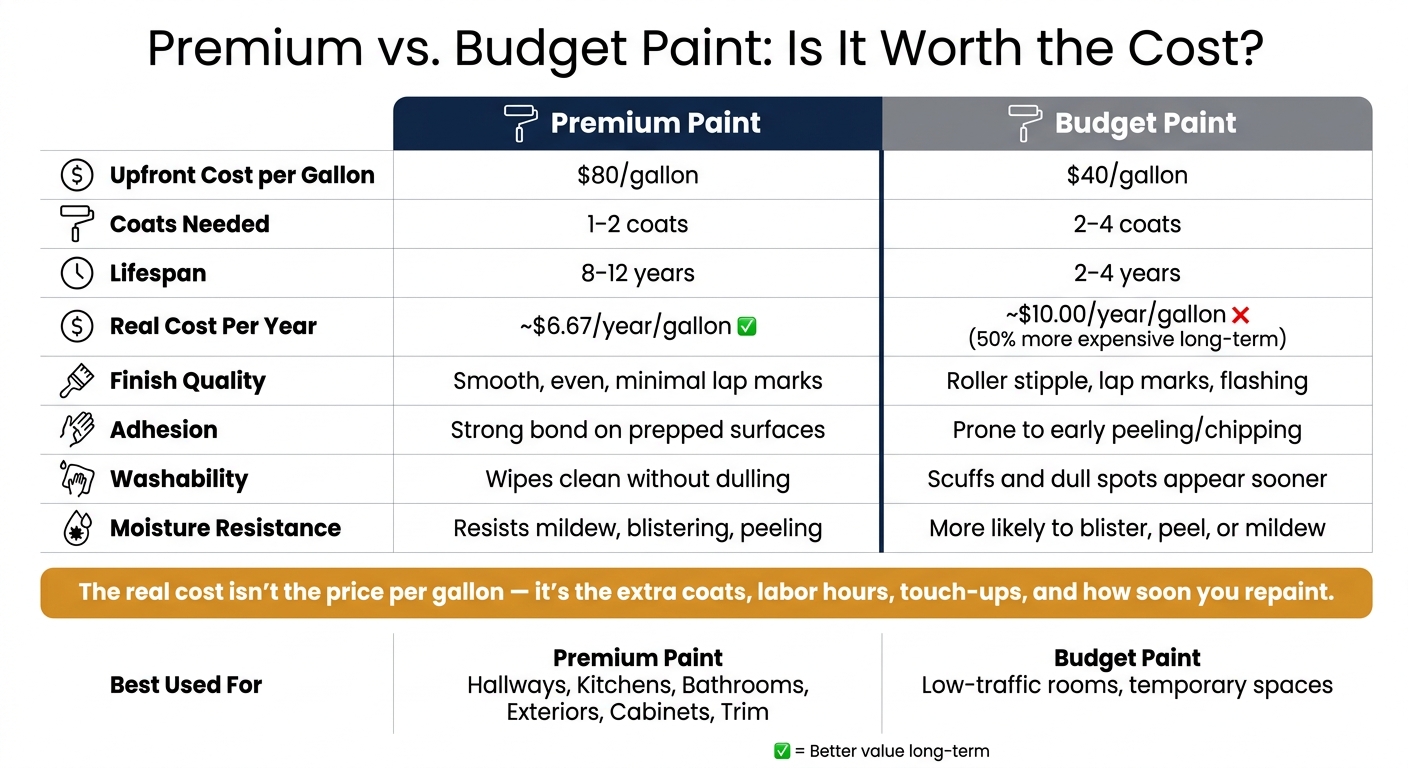
Premium vs. Budget Paint: True Cost & Performance Comparison
$25 vs. $100 Paint: Can You REALLY Tell the Difference? We Put It To The Test!
sbb-itb-a2baf13
Premium paint vs. budget paint: the core tradeoff
Budget paint may look cheaper at the store, but that lower price can hide the real cost. In a 400 sq ft room, it can end up costing more once you factor in extra labor and a third coat. For pros, premium paint matters because it helps protect both the finish and the schedule. That difference tends to show up first in labor hours and coat count.
In most cases, premium paint comes out ahead on coverage, durability, and upkeep, which can lower the total cost of the job. And it doesn’t stop there. The same difference also affects how the paint goes on and how well the finish lasts over time.
How fewer coats can change total project cost
Premium paint often covers in one to two coats. Budget paint more often needs two to four, especially over dark colors, patched drywall, or stained surfaces. That gap matters because labor is usually the biggest cost on most paint jobs.
Every extra coat adds more time on the wall. And more time means more labor cost. So while the gallon price gets most of the attention, it’s only one part of the picture. Once you account for added coats and added hours, the numbers often lean toward the pricier product, especially on larger rooms, full-house repaints, or any job where a clean, even finish matters.
How long-term maintenance affects real value
A cost-per-year comparison makes the value gap pretty clear. A premium paint at $80 per gallon that lasts about 12 years works out to around $6.67 per year per gallon. A budget paint at $40 per gallon that lasts only 4 years comes to about $10 per year per gallon. That’s roughly 50% higher over the life of the coating.
Over time, premium paint often costs less per year because it lasts longer and cuts down on how often repainting is needed.
Why professionals choose premium paint for application and finish
Price is only part of the equation. Premium paint also changes how the job goes on. And that has a direct effect on how the finished surface looks.
Better coverage and smoother flow on walls, trim, and cabinets
Premium paint flows and levels better, so it spreads more evenly and dries with a smoother look. That makes it easier to get a flat, even finish without as many roller texture lines or brush ridges.
You notice this fast on trim, cabinets, and window casings. Those surfaces don’t hide much. Brush marks and lap lines can stand out almost right away. Better leveling helps each new stroke blend in more cleanly too.
Common issues like lap marks, roller stipple, and flashing are also less likely with premium paint. The leveling ingredients help keep the wet edge open longer, which gives new strokes more time to blend into the last ones before the film starts to set.
That gap shows up fastest on detailed surfaces, where every small flaw is easier to spot.
Stronger adhesion on properly prepared surfaces
Premium paint bonds more tightly to properly prepared drywall, wood trim, and cabinets. That can cut down on peeling, chipping, and early wear in spots that get touched, cleaned, or bumped a lot.
It also tends to hold better over existing coatings, especially on glossy or heavily repainted surfaces, where weaker binders are more likely to fail.
Prep still matters. A lot. But premium paint helps that prep pay off and can reduce touch-up work later.
Those application gains matter most in rooms and on surfaces that take the most wear.
Where premium paint delivers the most value over time
Once coverage and finish are handled, premium paint starts to prove itself in the rooms and surfaces that get hit the hardest. It matters most where walls, trim, and cabinets deal with constant use day after day.
High-traffic interiors: washability, scuff resistance, and color retention
Hallways, stairwells, kitchens, and family rooms take a beating. Backpacks brush the walls, hands leave marks, and people clean those surfaces often. In spaces like that, budget paint tends to show dull spots, scuffs, and uneven sheen much sooner.
Premium washable coatings use stronger binders that help keep marks closer to the surface, so they wipe off more easily. In plain English, soap and water are more likely to remove the mess without dulling the color or leaving shiny patches behind. In busy hallways and kitchens, that gap can stretch the usable life of the finish well past what a budget product usually delivers. And in these rooms, scrub-resistance ratings matter more than whatever the label promises.
That same edge shows up anywhere moisture or repeated cleaning puts extra stress on the paint.
Bathrooms, laundry rooms, and exteriors: moisture and mildew resistance
Standard interior paint, even in semi-gloss, usually doesn’t have the additives needed for damp rooms.
Premium coatings made for moisture-prone spaces include mildew-resistant additives and moisture-resistant resins that form a tighter, less porous surface. That combo helps the finish resist mildew longer, especially in bathrooms or laundry rooms with weak ventilation.
The same idea carries outside. New Jersey’s freeze-thaw cycles, summer humidity, and coastal conditions put real stress on exterior paint. Premium exterior formulas use UV-stable pigments and flexible binders that help resist cracking, chalking, and mildew on north-facing siding and shaded trim, where moisture tends to hang around. That can cut down how often a homeowner needs to repaint while helping the outside of the house keep its look longer.
On trim and cabinetry, durability matters even more, because edges and contact points are usually the first areas to give out.
Cabinets and detailed surfaces: durability under frequent use
Cabinets, doors, and trim don’t take the same broad wear as walls, but they get touched all the time. Cabinet faces near pulls and knobs, door edges, and baseboard corners all deal with repeated contact, cleaning, and friction.
Premium cabinet and trim paints use harder resin systems that create a tighter, enamel-like film. That harder finish helps resist chipping on edges, cuts down grime buildup around handles, and stands up better to repeated cleaning with degreasers or disinfectants without turning dull or blotchy.
Over 5–10 years, the difference between premium and budget paint on cabinets and trim is usually easy to spot. Budget semi-gloss trim paint tends to chip faster at corners and door edges, and cleaning can leave burnished patches or faded color, especially on darker finishes. Premium enamels are more likely to stay even and solid, which means less sanding, fewer spot repairs, and a finish that still looks deliberate instead of worn out.
Conclusion: Why premium paint supports professional-level results
Once you look at coverage, adhesion, and durability, the main point is pretty simple: the price per gallon is only one part of the cost.
A paint that costs more up front can still cost less over time. Why? Because you may need fewer coats, repaint less often, and spend less time and money on upkeep. Longer service life means fewer repaints and lower maintenance. Better hide, adhesion, color retention, washability, and flow help the finish keep that clean, professional look for longer.
Key takeaways for choosing paint by project
That’s why the surface itself should guide your choice. Match paint quality to how the surface is used, not just to the lowest shelf price.
Use premium paint on surfaces that get touched, cleaned, noticed, or exposed to moisture. That includes:
- Hallways
- Kitchens
- Baths
- Exteriors
- Cabinets
Living rooms, bathrooms, exterior siding and trim, and cabinets all fall into that group. By contrast, low-traffic spaces matter less when you’re deciding whether to pay more for premium paint.
Even a small up-front price jump can save much more later through fewer repaints and less maintenance. The payoff is simple: a cleaner, tougher finish that still looks professional years down the line.
FAQs
Is premium paint worth it for one room?
Yes. Premium paint usually costs 20%–30% more upfront, but it often gives you better coverage and may need fewer coats to get that professional-looking finish.
That higher price can pay off in day-to-day use too. Premium paint tends to last longer, cleans up more easily in high-traffic areas, and keeps its look for more time. In bathrooms or rooms where stains show up fast, higher-end formulas can mean less maintenance and fewer touch-ups over time.
When is budget paint good enough?
Budget paint is often good enough for ceilings and low-traffic areas where durability, washability, and moisture resistance don’t matter much. It can also be a solid pick for rooms that see little wear, like adult bedrooms or formal dining rooms.
But in busy, damp, or often-cleaned spaces, the gap gets a lot more obvious. Budget paint often starts to wear out within 3 to 5 years, while premium paint can last up to 10 years and usually needs fewer repaints.
Does premium paint still need primer?
Yes. Even with premium paint, primer still matters if you want a professional-looking result.
It seals the surface, evens out how the material absorbs paint, and helps the topcoat stick the way it should.
If you skip primer, you can end up with an uneven finish, weak adhesion, peeling, or moisture damage. Premium paint may cover better, but it doesn’t replace a dedicated primer.