
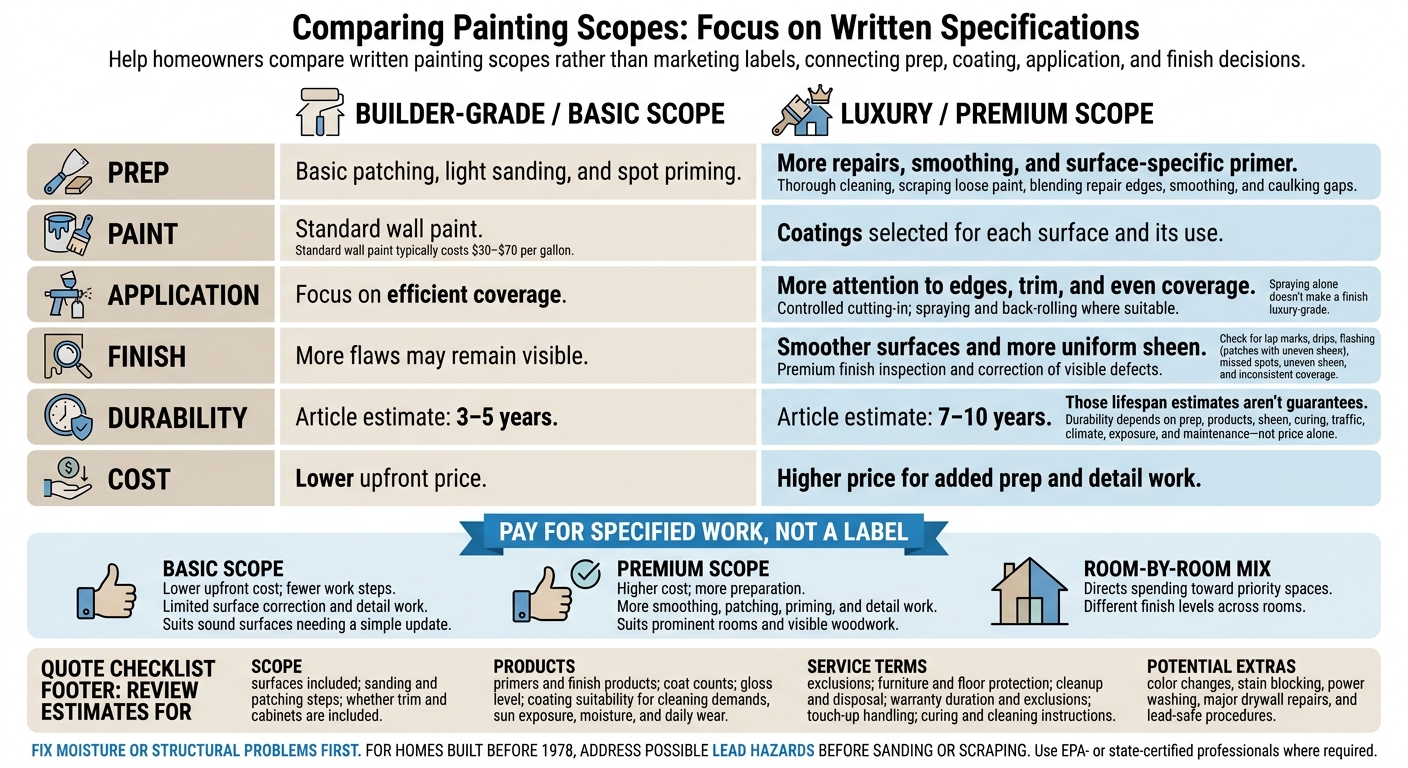
I’d compare the written work scope – not the “luxury” label. Builder-grade painting usually costs less because it includes less prep and detail work. Luxury painting should include more surface repairs, coatings suited to the job, and closer finish checks.
Here’s how I’d compare your options:
Quick Comparison
| What to compare | Builder-grade painting | Luxury painting |
|---|---|---|
| Prep | Basic patching, light sanding, and spot priming | More repairs, smoothing, and surface-specific primer |
| Paint | Standard wall paint | Coatings selected for each surface and its use |
| Application | Focus on efficient coverage | More attention to edges, trim, and even coverage |
| Finish | More flaws may remain visible | Smoother surfaces and more uniform sheen |
| Durability | Article estimate: 3–5 years | Article estimate: 7–10 years |
| Cost | Lower upfront price | Higher price for added prep and detail work |
Those lifespan estimates aren’t guarantees. I’d check product names, coat counts, protection, cleanup, exclusions, and warranty terms before signing. You can also choose more detailed work for prominent rooms and a basic scope elsewhere.
My rule: <u>pay for specified work, not a label</u>. Fix moisture or structural problems first, and address possible lead hazards before sanding or scraping a home built before 1978.
Builder-Grade vs. Luxury Painting: Compare the Scope
1. Builder-Grade Painting
Surface Preparation
Builder-grade painting usually involves basic cleaning, patching nail holes, limited sanding, and spot priming. Drop cloths and coverings protect nearby surfaces. This lighter prep keeps material and finish costs low, but it also affects how the finished paint looks.
Paint Quality
Standard wall paint typically costs $30–$70 per gallon.
Application and Detail Work
Painters generally use standard brushes, rollers, and trays for builder-grade work.
Appearance and Durability
Expect streaks, uneven coverage, and earlier chipping. Builder-grade finishes typically last 3–5 years before they need touch-ups or repainting.
Luxury painting addresses these areas with more thorough prep, better coatings, and closer control over the finish.
sbb-itb-a2baf13
2. Luxury Painting
Surface Preparation
Luxury painting goes beyond builder-grade work with a written prep scope. It should spell out repairs, sanding, hole patching, and primer suited to the surface. A premium finish alone isn’t enough.
Paint Quality
A luxury quote should specify more than standard wall paint. It should name coatings suited to each surface and the room’s conditions. Those coatings should provide even coverage and stand up to daily wear and temperature changes.
Application and Detail Work
Once you’ve chosen the coating, how it’s applied determines the final look. Precise trim work and quality brushes and rollers matter. Look for crisp edges, even coverage, and no visible streaks.
Appearance and Durability
A well-applied professional finish can typically last 7–10 years, but a luxury label doesn’t guarantee that lifespan. Surface condition, coating choice, and maintenance all affect how long the finish lasts.
Comparing Surface Preparation and Paint Quality
Surface Preparation
Compare quotes by the prep tasks included, not the grade name. The task list tells you what work you’re paying for.
| Item | Basic scope | Luxury scope |
|---|---|---|
| Preparation tasks | Basic patching and light sanding | Thorough cleaning, scraping loose paint, blending repair edges, smoothing, and caulking gaps |
| Primer selection | Limited or general-purpose priming | Primer matched to the surface and adhesion needs |
| Coating suitability | Standard wall paint; defects may remain visible | Coatings matched to the surface, washability, gloss level, sun, moisture, and daily wear; better adhesion and fewer visible repairs |
Once you’ve defined the prep work, compare how the coating will be applied.
Prep helps paint stick, but it can’t fix moisture or structural problems. Those issues need to be corrected before painting.
Paint Quality
Compare coating specs – not labels or price alone. Ask whether the selected finish suits the surface, cleaning demands, sun exposure, moisture, and daily wear. The quote should also specify the gloss level so you know what appearance to expect.
Even premium paint can fail over dirt, loose material, glossy surfaces, or poorly smoothed repairs.
Comparing Application, Finish, and Durability
Application and Detail Work
Once prep and product choices are settled, application shapes the final look. Builder-grade work focuses on efficient coverage. Luxury work puts more attention into controlled cutting-in and precise trim work.
Spraying alone doesn’t make a finish luxury-grade. Spraying and back-rolling should fit the surface and coating – not act as a quality label.
| Item | Basic scope | Luxury scope |
|---|---|---|
| Application | Efficient coverage | Controlled cutting-in; spraying and back-rolling where suitable |
| Trim precision | Basic edge work | More precise edges and detailed trim work |
| Final inspection | Less extensive finish checks | Thorough inspection and correction of visible defects |
| Appearance | Greater chance of streaks or uneven coverage | More uniform coverage and sheen |
| Touch-ups | Local repairs may be more noticeable | Touch-up patches are less visible |
Before signing off, check the finish against the quoted scope. Look for lap marks, drips, flashing, missed spots, uneven sheen, and inconsistent coverage. Flashing means patches with uneven sheen. Ask whether the scope includes correcting these defects.
Appearance and Durability
A polished look doesn’t guarantee better wear. Durability depends on prep, products, sheen, curing, traffic, climate, exposure, and maintenance – not price alone. Thorough prep and suitable materials help a finish last longer, but climate and temperature changes still affect performance.
Ask for the coating’s curing and cleaning instructions before washing newly painted surfaces. Clarify how touch-ups will be handled, too. A quoted lifespan isn’t a guarantee: repainting needs vary with room use, outdoor exposure, and regular care.
These differences appear in the quote and help determine the cost.
Comparing Costs and Choosing the Right Finish
Once you understand the differences in prep and finish quality, compare written scopes first, then review each quote line by line. More prep, protection, and detail work increase labor and material costs.
| Finish choice | Pros | Cons |
|---|---|---|
| Basic scope | Lower upfront cost; fewer work steps | Limited surface correction and detail work |
| Premium scope | More smoothing, patching, priming, and detail work | Higher cost; more preparation |
| Room-by-room mix | Directs spending toward priority spaces | Different finish levels across rooms |
The cheapest bid isn’t always the best value. The scope shows what you’re getting for the price.
Quote checklist: Ask the painter to list the surfaces included, sanding and patching steps, primers and finish products, and coat counts. Make sure the quote states whether trim and cabinets are included. Confirm exclusions, furniture and floor protection, cleanup and disposal, plus the warranty’s duration and exclusions.
Ask what costs extra, including color changes, stain blocking, power washing, major drywall repairs, and lead-safe procedures. Use EPA– or state-certified professionals where required. For homes built before 1978, address possible lead hazards before sanding or scraping.[1]
Basic work suits sound surfaces that just need a simple update. Higher-end finishing suits prominent rooms and visible woodwork. Match the scope to each room, its surface condition, and the finish you want.
FAQs
How can I verify a painter’s luxury finish claims?
Hold a work light at a low angle to the wall to spot ridges, tape lines, and other flaws. Run your fingertips or a flexible putty knife across seams and transitions to feel for bumps.
Ask the painter about thorough cleaning, sanding, and high-quality primers to prevent flashing – an uneven sheen. Request a professional on-site estimate to assess their experience with complex prep work and premium coatings.
Can my builder-grade paint be upgraded without stripping it?
Yes, you can often upgrade builder-grade paint without stripping it. A durable, professional finish depends on careful surface prep – not complete paint removal.
Clean off dirt, grease, and other contaminants, then repair any imperfections. Scrape and sand spots where the paint is peeling or failing. Sand glossy areas to help the new paint adhere, then apply a high-quality primer to create a solid, even base.
When is luxury painting worth the extra cost?
Luxury painting is worth the extra cost when you want long-term durability, a flawless appearance, and protection for your property. Careful surface preparation and premium coatings help the finish last longer, reducing repainting and maintenance costs.
It’s especially useful in high-traffic areas, on complex architectural features, and with high-sheen finishes that make imperfections stand out. Professional expertise also matters when working with specialty surfaces or tight deadlines, where precision, safety, and an even finish are key.