
If you want the smoothest cabinet finish, I’d lean toward spraying. If you want less mess, lower tool cost, and a simpler DIY job, I’d pick brushing and rolling.
Cabinet painting usually costs $1,500 to $10,000, with many mid-size kitchens landing around $4,500 to $7,000. So the method matters. It affects finish quality, prep time, room downtime, tool cost, and how much work you take on.
Before I choose, I’d look at these points first:
- Finish: Spraying gives a more even, factory-style look.
- Prep: Brushing and rolling need far less masking.
- Speed: Spraying is faster after setup, but setup takes longer.
- Skill: Brushing is easier for most DIY jobs.
- Best fit: Spraying suits full kitchens and flat doors; brushing suits small jobs, vanities, and built-ins.
- Hybrid option: Many pros spray doors and drawer fronts, then brush or roll frames.
Bottom line: spray for the best look on big, high-visibility jobs; brush and roll for smaller spaces, tighter budgets, and homes where you still need to use the room.
The Truth About Spraying vs Brushing Cabinets | What You Need to Know
sbb-itb-a2baf13
Quick Comparison
| Factor | Spray Painting | Brushing / Rolling |
|---|---|---|
| Finish | Smooth, factory-style | Slight texture may show |
| Prep time | High | Lower |
| Masking | A lot | Limited |
| Application speed | Fast once setup is done | Slower coat by coat |
| Skill level | Higher | More DIY-friendly |
| Overspray risk | Yes | Low |
| Tool cost | Higher, often $350 to $500+ for setup | Lower, often $20 to $40 |
| Best for | Full kitchens, many doors, flat panels | Small jobs, touch-ups, lived-in spaces |
If I were deciding fast, I’d use one simple rule: pick the method that matches the finish you want and the disruption you can live with.
Spray Painting Cabinets: Pros and Cons
Spray painting gives cabinets the smoothest finish of the three main methods. You’ll notice that most on flat panels and under bright lighting. The catch is simple: better finish usually means more setup and more room for error. That tradeoff is what separates spraying from brushing and rolling.
| Pros | Cons |
|---|---|
| Very smooth, factory-smooth finish with no brush marks | Extensive masking required before spraying begins |
| Even sheen and color across all doors and frames | Overspray can settle on unprotected floors, appliances, and hardware |
| Fast on large projects once setup is complete | Steeper learning curve – technique issues can cause runs, sags, and striping |
| Excellent coverage on intricate profiles and raised panels | A DIY spray setup and masking supplies can run $350–$500+ |
| Less waste than airless spraying | Uses more paint than brushing |
Where Spray Painting Works Best
Spray painting tends to make the most sense on larger kitchen projects with lots of doors and drawer fronts. The prep takes time, but once the masking is finished, spraying often moves faster than brushing. That’s why it works well for bigger kitchens, built-ins, and doors with detailed profiles.
It also fits cabinet styles where a sleek, low-texture surface is part of the look. Flat slab doors and simple shaker profiles are good examples. Raised panels and routed edges are easier to coat evenly with a sprayer too, since a brush can leave heavy paint buildup in recessed areas. Use a cabinet-grade enamel that levels well under spray.
What Makes Spray Painting Harder to Manage
Masking is the biggest time drain. Countertops, backsplashes, appliances, floors, vents, and nearby room openings all need plastic and tape.
Overspray is the other big issue. Fine paint mist can land on nearby surfaces, so you need tight masking and strong ventilation.
Then there’s technique. Spraying sounds simple until you try to keep the same distance, overlap each pass evenly, and move at a steady speed. Most first-time sprayers need practice. You also have to thin the paint the right way, then adjust the fluid flow and fan pattern. That adds one more layer of setup that brushing doesn’t ask for.
If setup and control matter more to you than speed and finish quality, brushing and rolling are usually the easier path.
Brushing and Rolling Cabinets: Pros and Cons
When spray prep feels too disruptive, brushing and rolling can be the simpler way forward. It’s a good fit for smaller jobs and lived-in homes where full spray containment just isn’t realistic.
| Pros | Cons |
|---|---|
| Low tool cost – brushes, rollers, and tape cost far less than spray equipment | Brush marks or roller stipple can show on large, flat door panels |
| Minimal masking | Slower on full kitchens with many doors and drawer fronts |
| Better control near edges, corners, and hardware openings | Maintaining a wet edge across wide surfaces takes focus |
| Easier touch-ups – no spray equipment needed for spot repairs | Sheen and texture can vary slightly across a large cabinet run |
| The room can stay partially usable | May need more coats to reach full, even coverage |
When Brushing and Rolling Make Sense
This method works best when the project is small or when the space makes spray containment a hassle. A powder room vanity, a laundry room with upper cabinets, or a mudroom built-in are all solid examples. There’s less surface area to cover, the layout is often tighter, and the time spent masking for a sprayer can eat up any speed gain that spraying might bring.
Tools matter here. A 2–2½-inch angled sash brush gives you better control on edges and trim. For door faces and flat panels, a high-density foam roller or a short-nap (3/16"–¼") microfiber roller covers more area in less time and leaves a finer finish than a brush by itself. Pair those with a self-leveling cabinet enamel, and the paint has a better chance to smooth out as it dries, which cuts down visible texture quite a bit. Light sanding between coats helps reduce texture too, though it also adds time.
Limits of a Hand-Applied Finish
Texture is the main tradeoff. Even with good tools and self-leveling paint, a brushed and rolled finish will still show some surface variation that a sprayer can avoid. On large, flat doors in direct light, that gap is usually easy to spot.
Speed is the other big limit. Painting a full kitchen by hand takes much longer than spraying once the spray setup is ready to go. And there’s a human factor too: fatigue can affect consistency. As the job drags on, changes in pressure and paint load can lead to slight sheen shifts across a long cabinet run.
For full kitchens where a near-factory finish is the goal, brushing and rolling on their own may fall short. But for smaller spaces, built-ins, or homes where people still need to use the kitchen during the project, this route often makes more sense on cost, disruption, and day-to-day use. Side by side, the tradeoff usually comes down to finish quality, speed, and setup.
Spray Painting vs. Brushing: A Direct Comparison
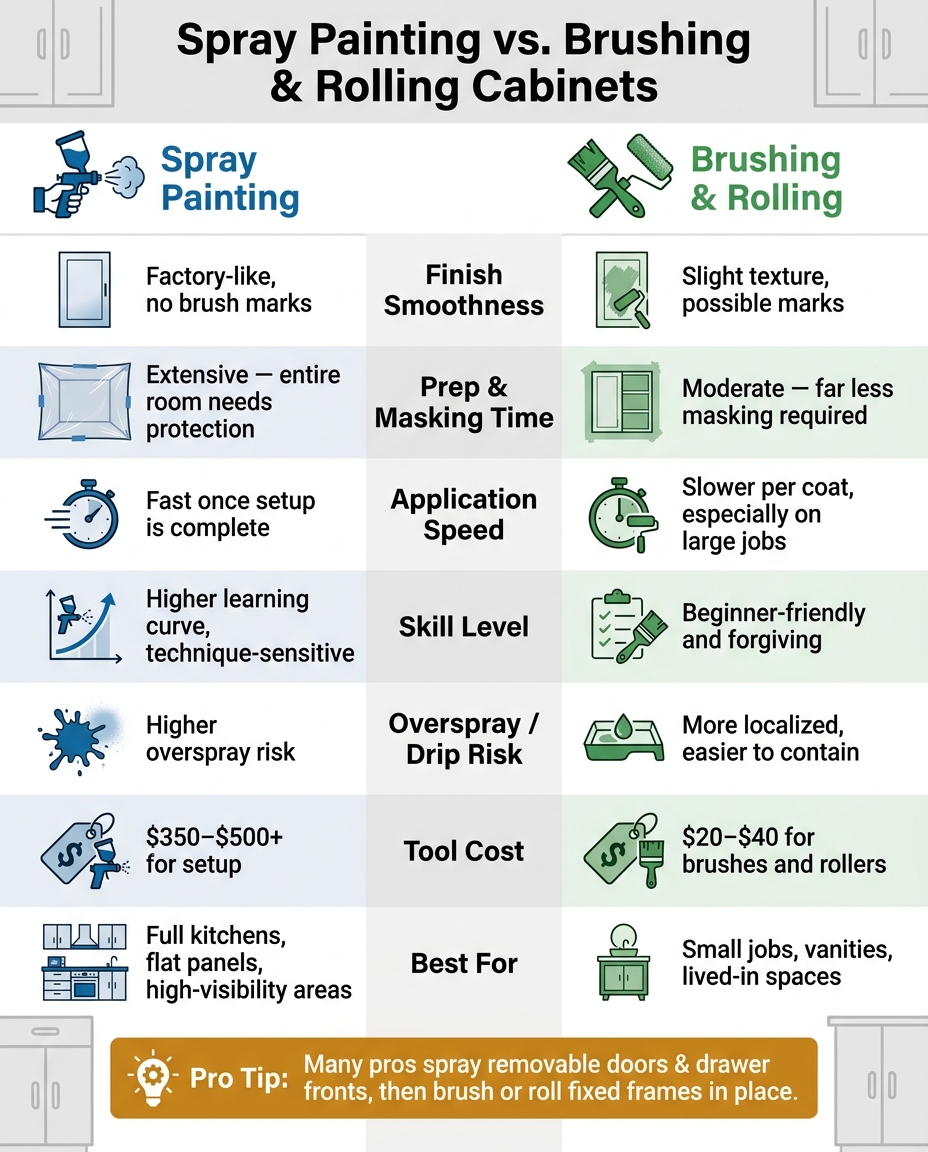
Spray Painting vs Brushing Cabinets: Side-by-Side Comparison
Once you compare them side by side, the tradeoff is pretty clear. Spraying tends to win on smoothness and speed after setup is finished. Brushing or rolling wins on ease, lower tool cost, and less disruption in the room. The table below pulls the main decision points into one view.
| Decision Factor | Spray Painting | Brushing / Rolling |
|---|---|---|
| Finish smoothness | Factory-like smoothness; no brush marks | Slight texture; possible brush or roller marks |
| Coat consistency and wear | More uniform film thickness with quality coatings | Can also be durable with quality paint; more technique-dependent |
| Prep and masking time | Extensive; entire room often needs protection | Moderate; far less room masking required |
| Project speed | Fast application once setup is complete | Slower per coat, especially on larger jobs |
| Overspray and drip control | Higher overspray risk; controlled by masking | More localized drips; easier to contain |
| Skill level | Higher learning curve; technique-sensitive | More beginner-friendly and forgiving |
| Total cost (U.S. dollars) | Higher tool and prep cost; more masking supplies and setup | Lower tool cost; brushes and rollers around $20–$40 |
Which Method Fits Common Cabinet Projects
Spraying makes more sense when you want a smoother finish across larger, high-visibility cabinet runs. Brushing or rolling is often the better fit for smaller jobs that don’t need that extra-polished look.
Take bathroom vanities or small built-ins. In those cases, brush and roller work often feels like the simpler call. The surface area is smaller, access is tighter, and all the masking and ventilation that spraying needs may not be worth the trouble.
In many cabinet jobs, the choice isn’t all-or-nothing. A lot of pros split the work: they spray the removable doors and drawer fronts, then brush or roll the fixed frames in place.
Why Lower Tool Cost Does Not Always Mean Lower Total Cost
A lower tool price doesn’t always lead to a lower total project cost. Spraying can cut labor time, while brush-and-roll can cut setup time. That’s the push and pull.
A sprayed finish is also usually more even and may keep its appearance longer. So the better option comes down to the size of the job, how visible the cabinets are, and how much the final finish matters.
Conclusion: When to Spray, When to Brush, and When to Call 26 Painting, LLC
Once you look at finish, prep, and day-to-day disruption, the choice tends to sort itself out. Pick the method based on the size of the project, the finish you want, and how much disruption your home can handle. Spray painting is usually the better fit for full kitchen layouts, open-concept spaces, and jobs where that factory-smooth look matters. Brushing and rolling makes more sense for smaller projects, tighter budgets, or homes that are too lived-in to seal off an entire room.
In plain terms, small jobs in less visible areas usually make sense for brush-and-roll. Large kitchens that people see every day often make spraying worth it.
Projects That Benefit From Professional Cabinet Repainting
Some cabinet projects are simple enough for a confident DIYer. Others get complicated fast, and that’s where hiring a pro can make a big difference.
Busy family kitchens, large layouts, and a showroom-quality finish are the clearest examples. These jobs often need deep degreasing, proper sanding, high-adhesion primers, and cabinet-grade enamels or 2K urethanes that cure into a harder, longer-lasting finish. Doing all of that well while also dealing with dust, overspray, and a home that still needs to function is a lot for one person to juggle.
Older homes can make things even trickier. Cabinets and trim in older homes may contain lead-based coatings, and sanding or scraping those surfaces without proper containment and cleanup can create serious health risks. As an EPA Lead-Safe Certified Firm, 26 Painting, LLC follows federal lead-safe guidelines for containment, dust control, and cleanup.
For more involved projects, 26 Painting, LLC offers free estimates and can look at your cabinets, your space, and your goals to suggest the right approach.
FAQs
How do I choose between spraying and brushing my cabinets?
Choose based on the finish you want, the size of the job, and how comfortable you are with the work. Spraying is the best pick if you want a smooth, pro-looking finish. It also works well for large cabinet jobs or cabinets with lots of detail. The trade-off? You’ll need to spend more time on prep and masking.
Brushing makes more sense for small touch-ups or tight, detailed spots where control matters more. Use high-quality synthetic brushes and apply thin, even coats.
For cabinet jobs where the finish has to look clean and hold up well, hiring a professional painter can be a smart move.
Is spray painting worth the extra prep and tool cost?
Often, yes – especially if you want a sleek, professional cabinet finish. Spray painting helps avoid streaks and the uneven texture that brushes can leave behind.
That said, it takes more prep, careful masking, and a steady hand. If you’re not comfortable with that process, 26 Painting, LLC can step in and handle it for you, delivering a durable, high-end result while saving you time and hassle.
Can I spray the doors and brush the frames?
You can, but it’s usually not the best move if you want a clean, professional look.
Spraying doors and brushing frames can leave visible differences in texture and sheen. If your goal is the most even, polished finish, use the same application method across the whole project.