
I’d pay more for paint only if it saves work or holds up better – not because the can says “premium.” Plan on two coats, even with premium paint, and test both options on the same prepared surface before buying.
Here’s what I’d compare:
- Coverage and hiding: How much wall does each gallon cover, and how many coats hide the old color?
- Finish: Does the dried paint look even, without streaks, patchy sheen, or visible touch-ups?
- Durability and cleaning: Can it handle your room’s scuffs, stains, moisture, and cleaning needs?
- Surface and prep: Does it suit the surface, and will you need a separate primer?
- Total cost: Count paint, prep, labor, downtime, and future repainting – not just the gallon price.
Quick Comparison
| What I’d check | Premium paint | Budget paint |
|---|---|---|
| Coverage and coats | May hide better; two coats are still common | May need more coats |
| Finish | May leave fewer application marks | Can look good with proper prep |
| Cleaning and wear | Worth paying for when stronger performance is documented | Can suit low-use rooms |
| Primer | May still need it | May still need it |
| Total cost | Higher paint cost may offset labor or repainting | Lower price helps if it adds no extra work |
In the article’s hypothetical example, doubling the gallon price from $35 to $70 increases the finished-job cost from $860 to $950 – about 10.5%. My rule: <u>buy the performance your room needs</u>, and check the label’s cure time before washing.
$25 vs. $100 Paint: Can You REALLY Tell the Difference? We Put It To The Test!
sbb-itb-a2baf13
Premium vs. Budget Paint: Coverage and Finish
The formula matters more than the “premium” label. Pigments affect how well paint hides the surface beneath it. Binders affect adhesion and durability. Volume solids tell you how much paint remains as a dry film after evaporation – but higher solids alone don’t mean better hiding. Check the technical data sheet, not just the label.
| Factor | Premium paint tendency | Budget paint tendency |
|---|---|---|
| Label coverage | May list about 350–450 sq. ft. per U.S. gallon on smooth surfaces | May list a similar range |
| Coat count | Better hiding may mean fewer coats; one-coat claims often fall short | May need extra coats for full hiding |
| Primer needs | May still need a dedicated primer | May still need a dedicated primer |
| Finish uniformity | May level better and produce a more even finish | Can still look even with proper prep and application |
These tendencies vary by product. They aren’t guarantees. Actual coverage and coat count depend on the surface, color change, application thickness, and formula. For a fair comparison, test both paints under the same conditions.
Test Coverage Under the Same Conditions
Keep the following conditions consistent when testing:
| Test control | What to keep consistent |
|---|---|
| Wall area | Test equal areas and account for openings separately |
| Preparation | Clean, repair, sand, and remove dust equally |
| Primer or existing coating | Use the same existing color and sheen or the same primer |
| Color | Compare similar colors; bright or deep colors and major color changes may need more coats |
| Sheen | Use the same sheen |
| Tools | Use identical roller covers and brushes |
| Application method | Match wet-film thickness, cut-in, rolling, and back-rolling |
| Drying time | Follow each label’s recoat instructions |
| Lighting | Use consistent natural, artificial, and side lighting |
Compare Coat Counts and Primer Needs
Coverage is the area paint coats. Hiding is how well it conceals what’s underneath. A gallon rated for 400 square feet can cover that area without fully hiding the old color. Some premium formulas hide in one or two coats, but difficult colors and major color changes can take more.
Primer serves a different purpose: it addresses uneven absorption, adhesion problems, or stains. Use primer for bare drywall, repaired areas, chalking, glossy coatings, odors, or major color changes. “Paint-and-primer-in-one” does not replace every dedicated primer.
Check the Finish After Drying
Inspect the dried finish at the stage recommended on the label. Paint in either price range won’t fix dents, grease, cracks, or poorly sanded patches.
| Finish factor | What to check |
|---|---|
| Leveling | Does the wet texture settle into an even film? |
| Brush and roller marks | Are ridges or uneven stippling visible after drying? |
| Lap marks | Do overlapping sections leave darker or shinier bands? |
| Flashing | Do patches reflect light differently? |
| Color and sheen consistency | Does the wall look even from different angles? |
| Edge coverage | Are corners and cut lines covered without heavy buildup? |
| Touch-ups | Does the repaired spot blend without a visible halo? |
Coverage and finish are only part of the comparison. Next comes how the paint holds up to cleaning and daily wear.
Durability and Washability by Room
Pay for scrub resistance where walls take a beating – not for the label alone. How often you clean, how much contact the walls get, and how hard they are to touch up should guide your choice. Room use matters more than price alone when choosing sheen and scrub resistance.
| Room or setting | Cleaning frequency and wear | Recommended performance |
|---|---|---|
| Low-traffic rooms | Occasional dusting and spot cleaning | Flat or eggshell is usually enough unless the room gets heavy use. |
| High-contact areas | Frequent scuffs, dirt, and hand contact | Washable eggshell or satin is usually worth the cost. |
| Kitchen | Grease, food splatter, and frequent wiping | Scrub-resistant satin or semi-gloss is usually the better fit. |
| Bathroom | Humidity, splashes, and repeated cleaning | Choose a washable, moisture-tolerant finish that handles repeated cleaning. |
| Business reception wall | Frequent cleaning and visible scuffs | Look for documented scrub resistance and color retention to cut maintenance and keep the wall looking good. |
Compare Scrub Resistance, Sheen, and Cure Time
Sheen plays a part, but the formula determines how well paint holds up to cleaning.
Washability means more than wiping away dust. Oils, scuffs, and stains can be harder to remove. Rubbing may also cause burnishing: shiny patches that stand out, especially on dark, low-sheen walls. Check the technical data for scrub resistance, cleaning instructions, surface-compatibility limits, and cure time. Compare scrub ratings only when the test methods and conditions are comparable.
| Finish | Typical cleaning performance | Main trade-off |
|---|---|---|
| Flat | Generally least forgiving of repeated scrubbing | Hides imperfections, but rubbing can leave shiny patches |
| Eggshell | Moderate washability | Balances low glare with cleaning tolerance |
| Satin | Generally better suited to frequent wiping | Makes dents, patches, and uneven texture more visible |
| Semi-gloss | Strong cleanability when formulated for the use | Reflects more light and highlights surface flaws |
A washable low-sheen paint can hold up better than a weaker, shinier coating. Dry to the touch does not mean fully cured. Full cure can take up to two weeks, and humidity or a thick application can slow the process. Wait for the manufacturer’s stated cure time before washing. Then test a mild cleaner in a hidden spot, using a soft cloth and light pressure.
Choose Paint for the Surface and Exposure
Use wall paint on walls, and use trim, cabinet, or exterior coatings only where intended. Don’t substitute interior paint for exterior paint. Likewise, don’t use exterior paint indoors unless the manufacturer specifically allows it.
Trim and cabinets need paint that stands up to repeated handling. Exterior coatings must handle rain, sunlight, and seasonal movement. Humidity, cold weather, seasonal temperature changes, and direct sunlight can affect both performance and drying. Follow the product’s weather limits and application instructions.
Fix moisture problems before painting. Repair leaks and improve exhaust ventilation. A tougher coating won’t stop recurring condensation or water intrusion. EPA guidance recommends indoor relative humidity around 30%–50% where practical. Low-VOC and durability are separate issues: check washability and intended use, and ventilate during application and curing.
When weighing costs, factor in labor and repainting: longer-lasting paint that’s easier to clean can reduce both.
Compare Total Project Costs
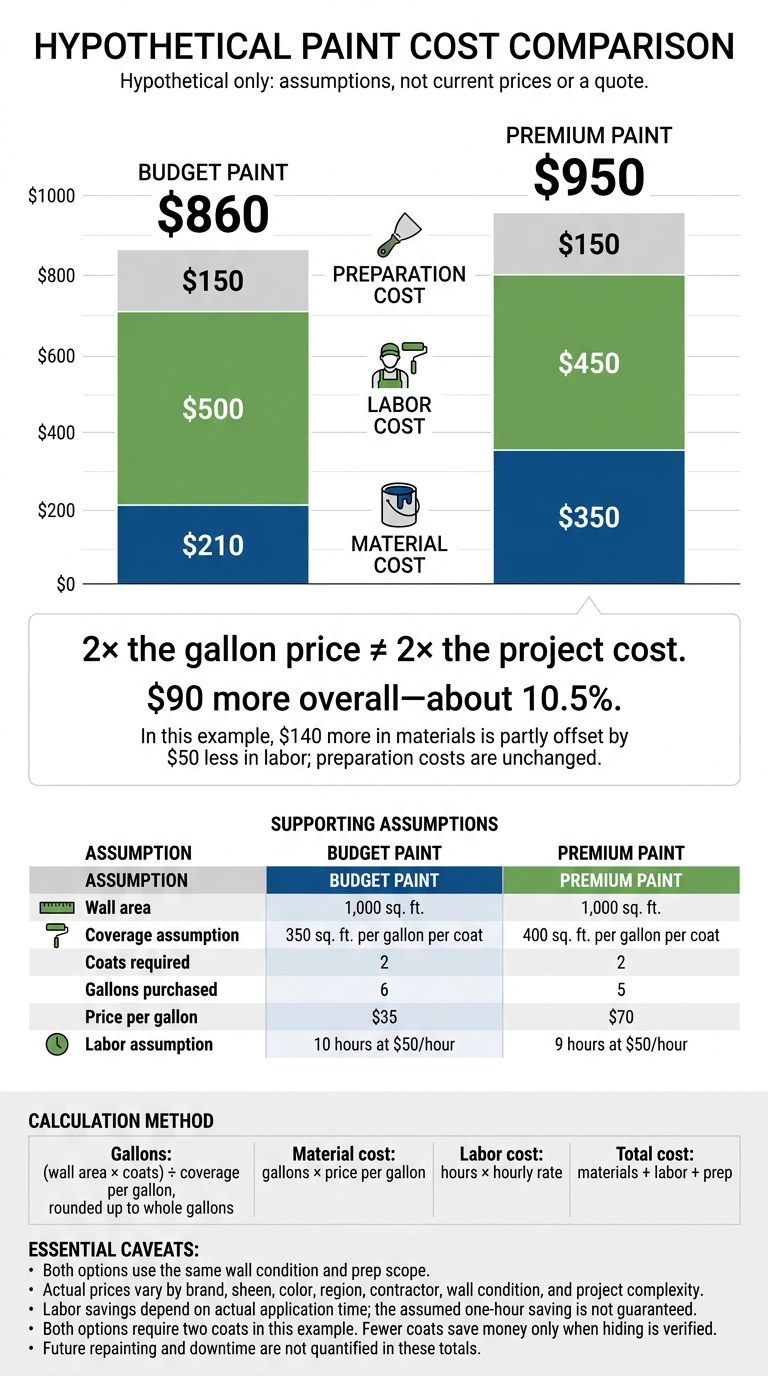
Premium vs. Budget Paint: Total Project Cost
Compare the finished job, not just the price per gallon. Coverage, coat count, and washability affect labor and how often you’ll need to repaint. Prep, labor, and extra visits can cost more than you save on materials.
For commercial spaces, account for coats, visits, and drying intervals. Each can limit access and add downtime. Build those performance differences into your total project estimate.
Calculate Paint and Labor Costs
Measure wall area, not floor area. Use the product’s stated coverage and calculate costs this way:
- Gallons: (wall area × coats) ÷ coverage per gallon, rounded up to whole gallons.
- Material cost: gallons × price per gallon.
- Labor cost: hours × hourly rate.
- Total cost: materials + labor + prep.
A higher paint price may change the final total only slightly – or not at all – once you factor in labor.
Hypothetical only: figures below are assumptions, not current prices or a quote. Both options use the same wall condition and prep scope. Actual prices vary by brand, sheen, color, region, contractor, wall condition, and project complexity.
Cost category Budget paint Premium paint Wall area 1,000 sq. ft. 1,000 sq. ft. Coverage assumption 350 sq. ft. per gallon per coat 400 sq. ft. per gallon per coat Coats required 2 2 Gallons purchased 6 5 Price per gallon $35 $70 Material cost $210 $350 Labor assumption 10 hours at $50/hour 9 hours at $50/hour Labor cost $500 $450 Preparation cost $150 $150 Hypothetical total $860 $950
Premium paint costs $90 more overall in this example. Labor savings depend on actual application time. Fewer coats save money only when you’ve verified that the paint hides the old color well enough.
Compare estimates that use the same prep standard, including primer, repairs, protection, cleanup, and return visits. Premium paint pays off only when better hide, durability, or drying time cuts labor or future repainting costs. Check those performance differences before using the totals to make your choice.
When Premium Paint Is Worth Paying For
Pay for a benefit you can measure. Check product data and use a test patch to assess hide or cleaning performance. Savings depend on how the space is used and how much labor the job needs.
| Project condition | Performance to look for | Cost effect |
|---|---|---|
| High-wear areas | Documented washability, scuff resistance, and stain resistance | Less touch-up and repainting |
| Frequent cleaning | Cleanability without finish damage | Fewer cleaning-related repairs |
| Difficult color changes | Strong hide verified by a test patch | Avoiding an additional coat |
| Disruptive repainting projects | Faster drying or shorter cure time, as documented | Less downtime and fewer work interruptions |
When Budget Paint Is Enough
Lower-cost paint makes sense when it meets the room’s needs without adding coats or maintenance. DIY time still has value, even if there’s no labor invoice. For rental turnovers, choose paint based on expected tenant wear – not just the lowest purchase price.
| Cost condition | Lower upfront cost makes sense when | Cost effect |
|---|---|---|
| Low-wear, short-service-life spaces | Cleaning is infrequent or repainting is already planned | Durability gains may not offset the price premium |
| Similar-color repaint | Sound, uniform walls need no extra coats | Lower material cost without added labor |
| DIY project | Extra application time is acceptable | Material savings may justify more personal time |
| Short turnaround and limited upkeep | The coating meets expected wear and scheduling needs | Savings hold only if extra coats or touch-ups do not add labor |
Conclusion: Choose Performance, Not Price
Coverage, coat count, finish, durability, washability, and total cost matter more than the brand name. Expensive paint is worth it when its performance cuts labor or delays repainting. Budget paint can work well in low-wear rooms with proper surface prep.
For indoor projects, low- or zero-VOC labels describe emissions – not coverage or wear resistance. Choose a lower-emission paint that also fits the room’s cleaning and wear needs.
For advice tailored to your project, request a free estimate from 26 Painting, LLC that includes a surface assessment. Ask for a written scope covering repairs, primer, coats, labor, and cleanup.
FAQs
How can I verify a paint’s durability claims?
Check the paint’s technical data sheet for scrub ratings – the number of cleaning cycles the finish can withstand. High-quality paints often hold up to 3,000 to 10,000 cycles. Look for labels that explicitly say “scrubbable” or “mold-resistant”.
For extra assurance, check for third-party certifications such as Green Seal, Greenguard Gold, or SCS Indoor Advantage.
When do labor savings justify pricier paint?
Higher-priced paint can earn its keep through better coverage and longer wear. Better coverage means fewer coats, while greater durability means less frequent repainting. Since labor often takes up most of a project’s budget, fewer coats can cut the total cost.
High-quality paints last two to three times longer than standard options, putting off future labor costs. Those savings matter most in high-traffic areas, where frequent cleaning and wear can lead to early repairs.
Can I use premium paint only on high-wear walls?
Yes. Premium paint on high-wear walls balances durability and cost. Its higher resin and binder content creates a tougher, more moisture-resistant surface that stands up better to frequent cleaning and heavy traffic.
You can also use sheen zoning: apply premium satin or semi-gloss paint to the lower 3 to 4 feet, where scuffs and impacts happen most often. Above that, use a more affordable paint or a lower-sheen finish.