
A higher painting quote may cover more work – not better work. If I’m comparing a $3,200 quote with a $5,100 quote, I want to know what the extra $1,900 buys before I choose.
I’d compare these items first:
- Surfaces and prep: Cleaning, repairs, sanding, caulking, and primer.
- Paint and coats: Exact product, sheen, and finish-coat count.
- Labor and setup: Furniture moving, protection, equipment, access, and scheduling.
- Cleanup and extra charges: Who handles each task, payment terms, and how added work gets approved.
- Insurance, lead safety, and warranty: Current records, any pre-1978 paint requirements, covered defects, and repair costs.
My rule: <u>compare the same work before comparing totals.</u> I’d mark each item included, excluded, or unclear, then get missing details and prices in writing – including any separate services.
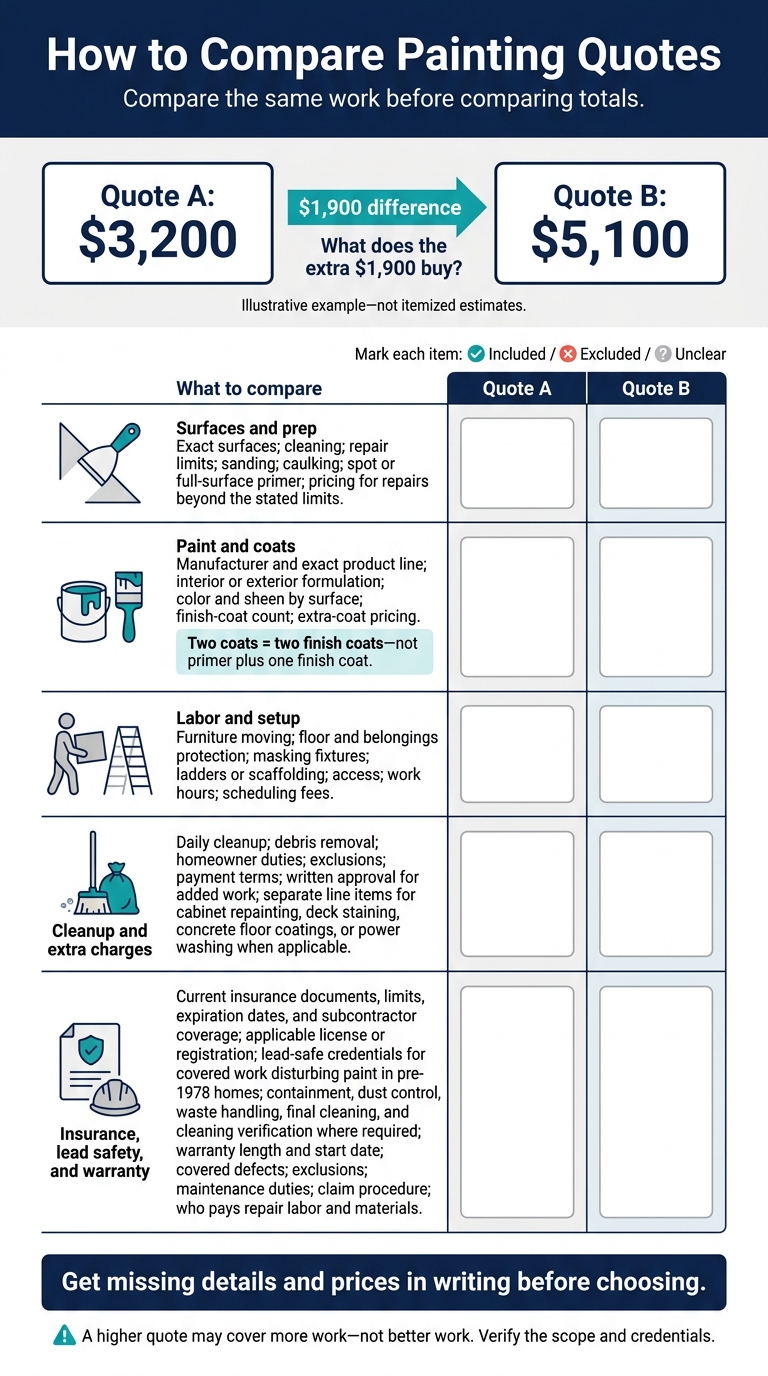
How to Compare Painting Quotes
Surface Preparation, Repairs, and Paint Choices
Cleaning, Surface Repairs, Sanding, and Priming
“Surface preparation included” needs written limits. The amount of prep affects labor hours and material use. Have the quote spell out repair limits, texture-matching requirements, and unit prices for work beyond those limits.
| Preparation task | What the quote should state | Risks if excluded |
|---|---|---|
| Cleaning and exterior washing | Areas, method, mildew treatment, chalk removal, and drying requirements | Poor adhesion or returning mildew |
| Filling and repairs | Nail-hole allowance; drywall, plaster, and wood repair limits; whether replacement is excluded | Visible damage or extra repair charges |
| Scraping and sanding | Loose-paint removal, edge smoothing, and spot sanding or full-surface sanding | Rough edges, poor adhesion, or continued peeling |
| Caulking | Gaps and failed joints included | Visible gaps or possible water entry |
| Spot priming | Bare, patched, or stained areas covered and primer type | Uneven sheen, visible patches, or stains showing through |
| Full-surface priming | Surfaces covered, primer type, and why it is needed | Uneven absorption or inconsistent coverage |
Spot work suits isolated damage. Porous, glossy, uneven, or moisture-damaged surfaces need more extensive prep. Outside, that work should address damaged wood and moisture sources – not just cover the damage.
Paint Product, Sheen, and Coat Count
“Paint included” does not tell you what you’re buying. The product line, sheen, and coat count can change the total, even for a seemingly simple color. Request the manufacturer, exact product line, interior or exterior formulation, color, and sheen for each surface. Count primer separately from finish coats.
| Quote language | Details to request | Possible cost effects |
|---|---|---|
| Paint product included | Manufacturer, product line, formulation, and products for walls, ceilings, trim, and doors | Durability, washability, and material prices differ |
| Exact sheen | Sheen for each surface | Glossy finishes can reveal defects and require more preparation |
| “Two coats” | Finish-coat count, primer locations, and primer type | Separate primer and finish applications add materials and labor |
| “Color change included” | Existing and new colors, coverage expectations, and extra-coat pricing | Dark, bright, or saturated colors may need extra coats or tinted primer |
| Low-VOC product | Product line, VOC designation, and ventilation duties | Product choice and occupant precautions can add cost |
Before a major color change, ask for a test area. Put in writing whether extra coats needed for uniform coverage are included or require written approval. Scrubbability depends on the product, not sheen alone.
Low-VOC, zero-VOC, and low-odor labels mean different things. Low odor doesn’t remove the need for ventilation or occupant precautions. EPA guidance recommends maximum ventilation during painting and for at least 72 hours afterward when practical.
sbb-itb-a2baf13
Labor, Access, and Jobsite Duties
If the prep and paint specs match, compare labor and jobsite duties next.
Labor covers more than painting. Does the quote include moving furniture, protecting floors and belongings, masking fixtures, cleanup, and working around people living in the home? A lower price may mean the property owner handles some labor-heavy tasks.
Protection, Furniture Moving, and Cleanup
Ask for written confirmation of what’s included and excluded for each duty below. That way, you can compare quotes for the same scope of work.
| Jobsite duty | Quote status | Details to confirm |
|---|---|---|
| Furniture moving | Included or excluded | Which items the crew moves and which you must clear |
| Floor and belongings protection | Included or excluded | Which areas get protection and who supplies coverings |
| Masking fixtures | Included or excluded | Which fixtures get covered and who removes masking |
| Daily cleanup and debris removal | Included or excluded | Daily cleanup tasks, final debris removal, and materials left for you |
| Equipment such as ladders or scaffolding | Included or excluded | Whether the price includes specialized equipment |
If people will live in the home during the job, put prep, cleanup, and covering removal duties in writing. Include how the crew will limit disruption.
Access, Scheduling, and Extra Charges
Confirm equipment costs in writing, including whether the price covers ladders or scaffolding.
Document work hours, access limits, and any schedule-based fees. Have every extra charge listed in writing before work begins.
Insurance, Lead Safety, and Warranties
Insurance and compliance costs can increase a quote, but higher overhead doesn’t prove better workmanship. Ask what the price includes, then verify the insurance certificate, lead-safe credential, and warranty terms.
After prep, paint, and labor, compliance and warranty coverage can account for the next price gap.
Insurance Records and Lead-Safe Requirements
Request current general liability and workers’ compensation documents when applicable, along with any required license or registration. Check the business name, coverage limits, and expiration dates. Confirm coverage with the insurer, and ask how the policy covers subcontractors. Get current, project-specific documents – not just a verbal assurance.
For homes built before 1978, work that disturbs paint may trigger EPA Renovation, Repair and Painting requirements. For covered work, request 26 Painting, LLC’s EPA Lead-Safe Certification – or state-equivalent credentials – and identify the certified renovator assigned to your job.
The written quote should spell out containment, dust control, waste handling, final cleaning, and cleaning verification. These requirements add labor and materials that an incomplete quote may omit.
Warranty Terms and Repair Duties
Compare covered defects and exclusions, not just the warranty’s length. Use this side-by-side check to spot differences in coverage and repair costs.
| Item to verify | Quote A: record details | Quote B: record details |
|---|---|---|
| Insurance documents | Coverage, limits, expiration dates, subcontractor coverage | Coverage, limits, expiration dates, subcontractor coverage |
| Warranty term | Exact length and start date | Exact length and start date |
| Covered defects | Peeling, blistering, flaking, adhesion failure | Peeling, blistering, flaking, adhesion failure |
| Exclusions | Moisture, leaks, surface movement, defective substrates | Moisture, leaks, surface movement, defective substrates |
| Maintenance duties | Required cleaning and upkeep | Required cleaning and upkeep |
| Claim procedure | Notice deadline, required evidence, inspection process | Notice deadline, required evidence, inspection process |
| Repair responsibilities | Who repairs or touches up; who pays labor and materials | Who repairs or touches up; who pays labor and materials |
A warranty doesn’t replace prep work or cover an excluded surface problem. Ask which moisture or substrate repairs the quote includes, who will perform them, and whether they cost extra. Check whether the exclusions leave likely failure points outside the coverage, even if the warranty lasts longer.
Conclusion: Compare Matching Scopes Before Choosing
When scope, materials, labor, and warranty terms are clear, price differences are easier to judge. A higher price makes sense only when it covers more work. Compare line items, not just totals.
Use a Written Quote Checklist
Check each quote for the exact surfaces, prep limits, primer, paint line, coat count, protection, cleanup, schedule, exclusions, payment terms, insurance, lead-safe compliance, warranty, and final walkthrough. Ask for any missing details in writing.
Define “two coats” as two finish coats, not primer plus one finish coat.
Request a Free Estimate From 26 Painting, LLC
Still unsure what the quote covers? Request a free estimate from 26 Painting, LLC for your New Jersey home or business. Ask for a written scope that lists surfaces, prep, paint products, coat count, protection, cleanup, schedule, exclusions, and warranty terms.
If the work includes cabinet repainting, deck staining, concrete floor coatings, or power washing, list each service as a separate line item.
FAQs
How can I tell if a higher painting quote is worth it?
Compare the scope of work, not just the total price. A higher quote may offer better long-term value if it includes thorough prep – scraping, sanding, and repairs – to help prevent paint from failing too soon.
Look for specific paint brands, the number of coats, and clear prep steps. A lower bid may skip needed work or come from a contractor without proper insurance, licensing, or EPA Lead-Safe certification. Those gaps could cost you more later.
Can I lower my painting quote without sacrificing durability?
To save money without sacrificing durability, reduce the scope of the project or focus on select areas of your home. Don’t cut back on prep work or use lower-quality materials.
Skipping cleaning, sanding, caulking, or priming can cause peeling, blistering, and early paint failure. Those shortcuts could leave you with a paint job that lasts only 1 to 3 years instead of 8 to 15 years.
What should I do if hidden damage raises the price?
If your contractor finds hidden damage after painting starts, ask for a written estimate before approving any extra work. Keep communication clear and document any changes so you both agree on the work and final cost.
Experts recommend setting aside 10% to 20% of your total budget for unexpected costs. Making repairs promptly is often necessary to help your paint job last and protect your warranty coverage.